
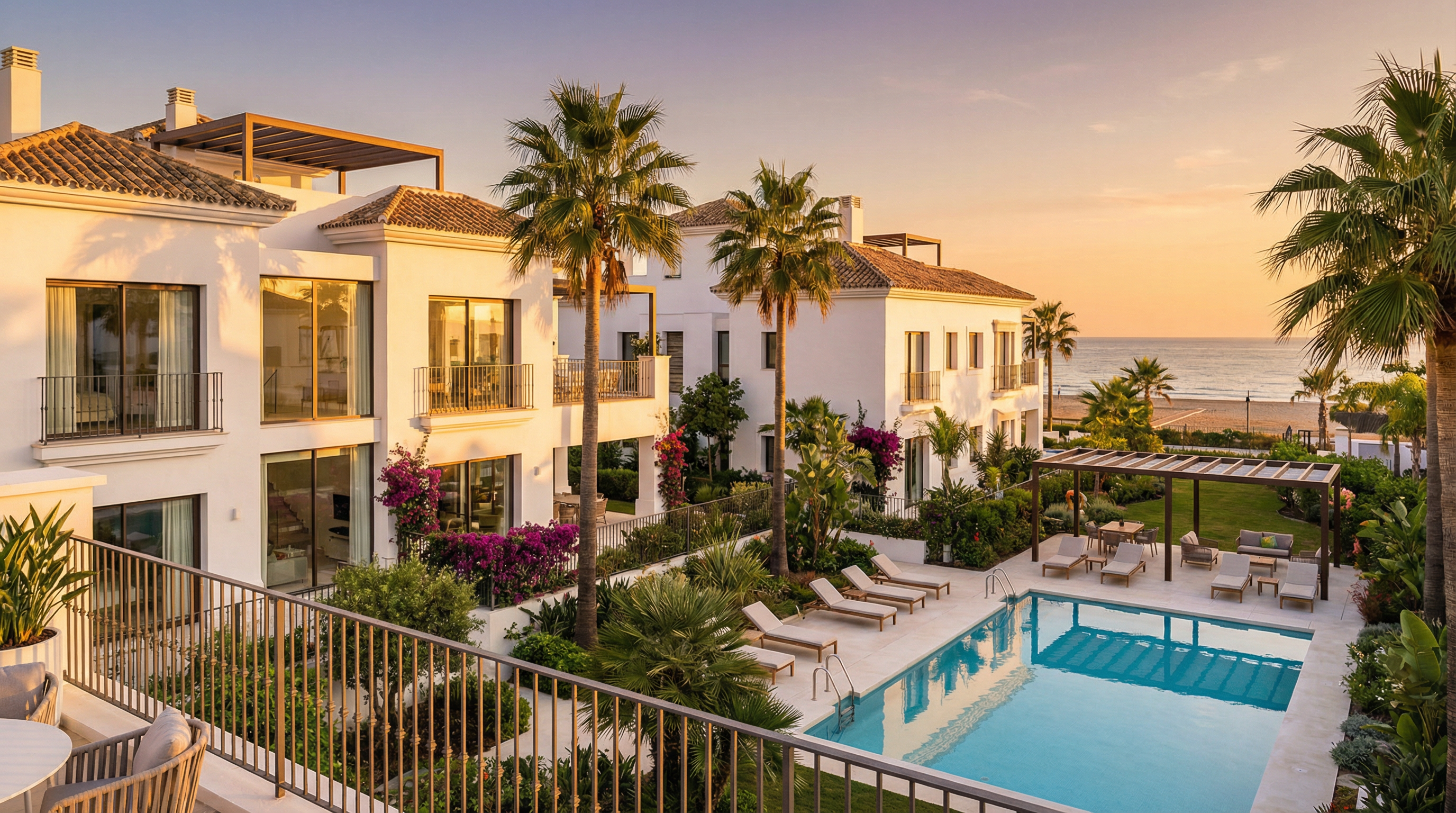
Sitting by the marina in Puerto Banús, we’re reminded daily that lifestyle is the true currency of property value on the Costa del Sol. In 2026, buyers aren’t just asking about bedrooms; they’re comparing gyms, heated pools, coworking lounges, golf access, wellness spaces, and energy ratings. After guiding 500+ families here, we’ve seen how the right amenities elevate everyday living—and the wrong ones only inflate community fees. This article distills what actually drives value, rentability, and long-term comfort so you can enjoy the Costa del Sol lifestyle without overpaying for unused features.
Why do amenities matter so much to value and rentability in 2026?
In today’s lifestyle real estate Costa del Sol market, amenities are the differentiators that transform a good home into a “booked all season” or “sold in weeks” asset. Buyers aged 45–70 want effortless living: step-free access, private parking, concierge, wellness, and quiet comfort—ideally with beach or golf access. Renters (and visiting family) want the same. When those needs align, value compounds.
Amenities impact three measurable outcomes: time-to-sale, rental yield, and ownership costs. A beachfront community with secure parking, lift access, and a heated pool typically sells faster and commands higher rates than a similar home lacking those features. Conversely, over-the-top facilities (think underused indoor courts) can bloat community fees without improving price per square meter.
From our files: a Benahavís buyer traded an older complex with cold pool and no gym for a resort with a heat-pump pool, small spa, and coworking lounge. Their winter occupancy rose 18% and time-to-sale projections tightened by 30–45 days, based on comparable resales nearby. The lesson: amenities must match real usage patterns.
Which luxury property amenities in Spain truly add value—and which don’t?
Across Marbella, Estepona, Mijas, Benalmádena, and Fuengirola, several amenities consistently lift value and rental demand. Others are nice-to-have, and some are cost traps. Below is our practical hierarchy for 2026.
High-impact essentials (value and rentability)
These features drive the strongest response from international buyers and guests, especially in the €400k–€4m band.
- Secure parking (preferably underground) and private storage: Key for year-round comfort and resale. EV-ready spots add future-proofing.
- Step-free lift access and accessibility: Crucial for 45–70 demographics and multi-generation stays.
- Heated outdoor pool (energy-efficient): Extends shoulder-season bookings and owner use. Heat pumps beat resistive heating on cost and sustainability.
- Modern gym + small spa: High usage-to-cost ratio; compact spa with sauna/steam is more efficient than sprawling facilities.
- 24/7 security and on-site concierge: Enhances peace of mind for lock-and-leave owners and boosts premium perception.
- High-speed fiber and coworking lounge: Increasingly decisive for workations, longer winter stays, and international buyers who mix leisure and business.
- Energy performance (A or B rating) and solar/heat-recovery systems: Cuts running costs and supports sustainable residential design demand .
Strategic differentiators (situational but powerful)
Use these to stand out—provided the community fees and real use justify them.
- Frontline golf or direct beach access: Premium positioning for both lifestyle and rental marketing; confirm club access terms and seasonal conditions.
- Clubhouse with casual dining: Often increases on-site activity and social value without heavy maintenance overhead.
- Children’s splash area and shaded play zones: Raises family appeal in summer weeks; low maintenance compared with full water parks.
- Padel/tennis (limited courts): High use on the Costa del Sol; avoid excessive court counts that inflate costs.
Nice-to-haves (low direct ROI)
They can delight owners but rarely move the rental dial enough to justify big cost.
- Large indoor pools without energy efficiency plans: High heating/ventilation costs; only choose if usage is high and systems are efficient.
- Extensive landscaped water features: Beautiful, but drought-sensitive and maintenance-heavy .
- Grand lobbies and art installations: Great first impression; limited impact on nightly rates or resale price.
How to run an amenity cost-benefit analysis before you buy
We’ve helped hundreds of families align amenities with their real lifestyle and investment goals. Here’s our step-by-step due diligence flow for lifestyle-driven property demand.
1) Map your usage and rental strategy
Write how you’ll live month by month: time on golf courses, spa frequency, work hours, family visits. Overlay rental goals: seasonal stays vs. year-round. This clarity narrows choices fast and avoids paying for unused facilities.
- Define top five must-haves (e.g., heated pool, EV-ready parking, coworking).
- Identify “delighters” you’ll use weekly, not annually.
2) Obtain and review community budgets
Ask for the last two years of community budgets, reserve fund balance, and meeting minutes. Look for energy costs, lifeguard staffing, and planned upgrades. Compare fees per apartment type and note any special assessments.
- Typical ranges: €150–€400/month for standard amenities; €400–€900+ for resort-style complexes, depending on unit size and services. Ranges vary by municipality and energy prices.
- Model 3–5 year fee projections assuming 3–6% inflation in services.
3) Quantify rental uplift
Estimate extra occupancy and nightly rate from specific amenities. For example, an efficient heated pool plus gym might add 10–20 winter nights at €150–€300/night, generating €1,500–€6,000/year. Compare to the amenity-related portion of your annual community fee.
- Validate assumptions with nearby comps and a professional manager .
- Ensure your home qualifies for legal tourist rentals if that’s your plan .
4) Inspect efficiency, not just aesthetics
Heated pools should run on heat pumps, ideally assisted by solar thermal/photovoltaic. Gyms need proper ventilation and durable equipment. Spas must show humidity, filtration, and maintenance logs. Efficient systems protect fees and comfort.
- Ask for equipment specs, service contracts, and energy-consumption history.
- Check the building’s energy certificate and insulation details .
5) Confirm rules that affect usage
Community statutes can limit short-term rentals, guest access to facilities, or padel court hours. If you buy expecting rental upside from a spa or coworking lounge, ensure guests have permitted access.
- Review statutes and last AGM minutes with your lawyer.
- Check municipal/Andalusian stay requirements (registration, guest ID) .
6) Stress-test for seasonality and drought
Ask how the complex operated during recent drought measures. Some communities limited pool refills and watering schedules. Efficient gardens and pools (covers, automated dosing) indicate resilient management and cost control.
- Request any contingency plans used in the last two summers .
- Check noise patterns from summer pool areas if you value quiet.
7) Align financing and insurance
For non-residents, review mortgage options early and verify that your lender accepts projected rental income where applicable . Confirm insurance costs for amenities like private spas or jacuzzis.
- Ask your broker to factor community fees into affordability and DSCR calculations.
- Confirm coverage for short-stay rentals if planned.
What are the biggest risks and hidden costs with amenity-rich communities?
Luxury amenities can elevate life—and silently erode returns if poorly planned. Here are the pitfalls we see most often and how to navigate them.
Escalating community fees
Complexes with oversized indoor pools, multiple lifeguarded zones, and large lawns can see fees climb quickly with energy and staffing costs. Compact, efficient facilities usually maintain more stable fees. Insist on audited accounts and energy-optimization plans .
- Ask if lifeguards are required seasonally or year-round (varies locally).
- Check tender cycles for energy and maintenance vendors.
Regulatory compliance and rental legality
To rent legally, register your property, meet equipment and information standards, and comply with guest ID reporting in Spain . Non-compliance risks fines and invalidates revenue assumptions.
- Confirm tourist license eligibility before committing to purchase.
- Validate community statutes on short-stay rentals.
Overbuilding the wrong features
We occasionally see lavish wine rooms, oversized cinemas, or vast co-labs that sit empty. Choose right-sized coworking—quiet booths, a meeting room, and strong Wi‑Fi—over expansive showpieces. The Startup Law’s digital-nomad visa continues to support this demand, but usability matters more than spectacle .
- Poll the current community usage before assuming demand.
- Prioritize acoustic treatment and lighting over fancy furniture.
Drought, sustainability, and comfort
Buyers increasingly value sustainable residential design: shaded terraces, cross-ventilation, water-wise landscaping, and smart irrigation. These features protect comfort and fees during warm months and drought advisories .
- Favor native planting and efficient pool systems with covers.
- Check irrigation metering and leak detection practices.
2026 market insights: where amenities pay off on the Costa del Sol
In Q1 2026, we see strong demand for wellness real estate Spain and golf resort property Costa del Sol, with clear price bands for quality new-builds:
- Marbella & Benahavís: €6,000–€12,000/m² for prime new-builds; resort-style amenities expected. Focus on efficient spas, concierge, and heated outdoor pools.
- Estepona: €4,000–€7,500/m²; beachside and frontline golf remain highly liquid with balanced fees.
- Mijas & Benalmádena: €3,500–€6,500/m²; strong value for communities with coworking lounges and gyms.
- Fuengirola: €3,800–€6,500/m²; urban amenities and transport access offset fewer on-site facilities.
International buyer preferences Spain continue to favor practical luxury over spectacle: secure parking, A/B energy ratings, manageable monthly fees, and right-sized wellness and coworking amenities residential Spain. Tourist arrivals and long-stay winter demand remain robust in Málaga province, reinforcing amenities impact rental demand .
Communities that blend privacy with services—think staffed lobbies, parcel rooms, maintenance on-call, and compact spa/fitness—achieve higher absorption and stronger resale momentum. We’re also seeing premium attached to EV infrastructure and solar integration as energy awareness grows.
Expert tips from 35+ years combined experience
These are the patterns we’ve seen hold true through cycles—practical guidance to secure both joy and value.
Prioritize high-usage, low-overhead features
Choose heated outdoor pools with covers over costly indoor complexes, compact gyms over mega fitness floors, and native landscaping over water-intensive lawns. These choices preserve comfort and fees.
- Ask for the facility usage report if available.
- Favor developments with energy dashboards and solar integration.
Validate rentability before paying resort premiums
Before paying extra for spa/coworking, confirm your guest access rights and the area’s real nightly rate deltas. A modest gym and efficient heated pool often deliver a better ROI than large spa complexes.
- Cross-check with two independent managers .
- Benchmark against similar units within 1–2 km radius.
Buy the best address you can afford—then the amenities
Within any complex, prime orientation, noise control, and parking convenience beat a fancier spa in a compromised location. You can upgrade interiors; you can’t move a building.
- Use area comparisons to calibrate priorities .
- Inspect at different times of day for noise, sun, and traffic.
Putting it all together—and your next steps
Amenities should enhance how you’ll live day to day and how your home performs when you’re away. In 2026, the winning formula is practical luxury: secure parking, accessibility, efficient wellness, coworking readiness, and energy-smart systems. These protect comfort, attract renters, and sustain value without runaway fees.
We’re happy to audit a short list with you—fees, rental viability, and sustainability—so you can buy with clarity. Explore our deep dives on tourist licensing, fees, and green new-builds, then book a discovery call with our team.
Buyer decision matrix
| Factor | Why it matters | What buyers should verify |
|---|---|---|
| Everyday use | The home must work outside holiday weeks. | Access, services, noise, parking, running costs and year-round comfort. |
| Resale | Practical use supports future demand. | Location, maintenance, rules, energy and local activity. |
| New build | Specifications shape comfort and costs. | Orientation, shade, ventilation, shared facilities, handover and aftercare. |
Local buyer context
Investment value needs realistic use, documented costs, demand, rules and a clear exit route.
A buyer comparing London, Belfast, Dublin, Manchester or Amsterdam routes usually weighs flight rhythm, family visits, remote work and quieter-month practicality.
For new builds, connect the topic with licences, payment plan, materials, shared facilities, handover and aftercare.
New-build focus: For new builds, connect the topic with licences, payment plan, materials, shared facilities, handover and aftercare.
