
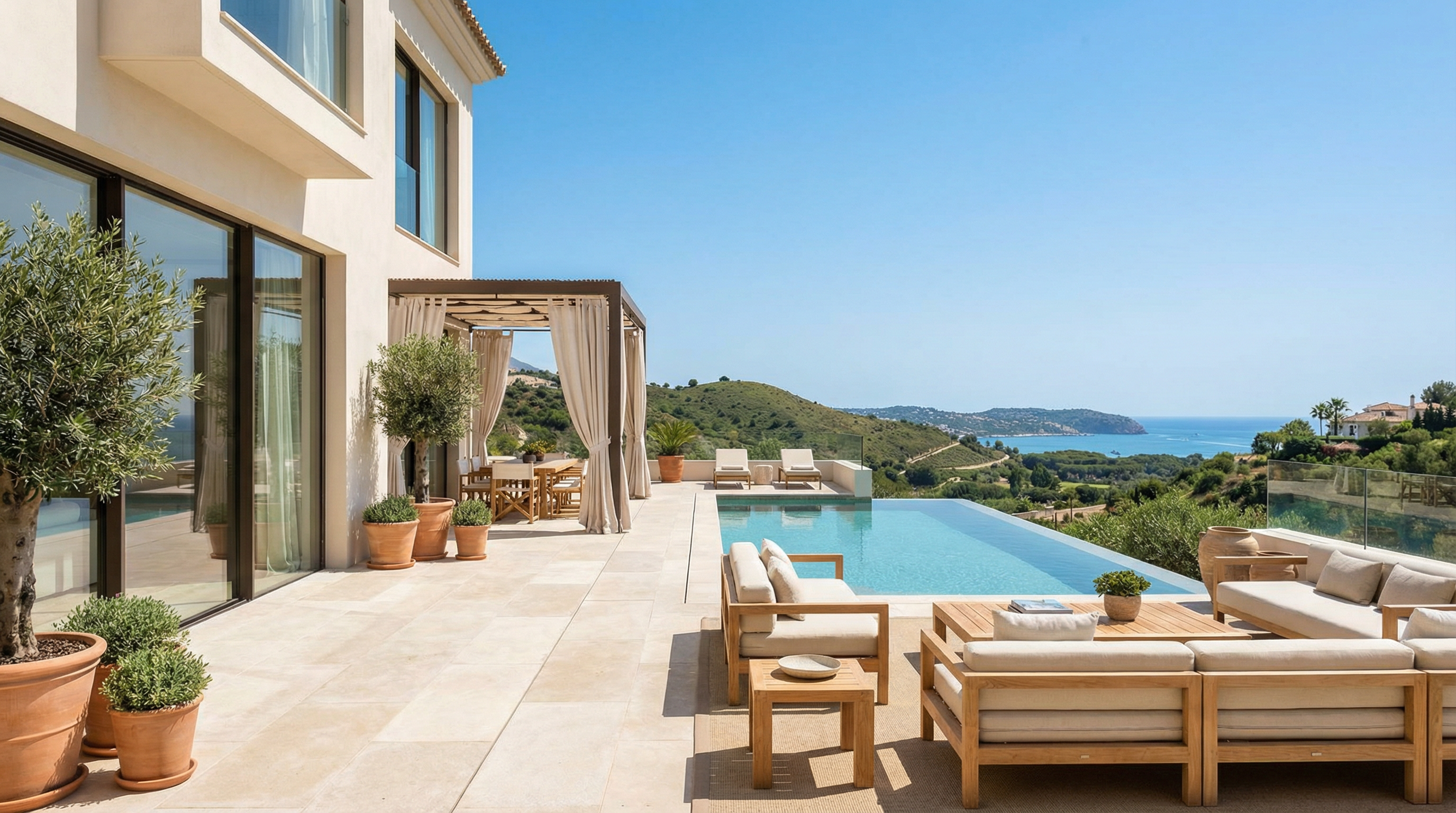
We’ve spent years helping clients buy property in Costa del Sol—many for a second home, others for investment—and the same truth keeps resurfacing: the region’s stability comes from a broad, modern economy, not just summer holidays. From Málaga’s tech growth to world-class healthcare and schools, this market runs 12 months a year. In this guide, we’ll unpack the real drivers so you can act with confidence.
Beyond the beaches: what really drives Costa del Sol’s property market?
When you picture Costa del Sol, you might think of Marbella’s marina or the boardwalk in Estepona. But behind the lifestyle scene lies a serious economic engine. Málaga has evolved into a European tech hub, tourism is now year-round, and transport infrastructure is best-in-class for Southern Europe.
In our experience guiding over 500 families, the buyers who succeed look at fundamentals first. Flight connectivity brings reliable demand, the local services economy creates high-quality jobs, and a deep pool of international residents ensures liquidity.This combination keeps the market attractive for those aiming to buy property in Costa del Sol as a second home or as a long-term investment.
Four pillars of stability
We see four pillars shaping demand across Marbella, Estepona, Fuengirola, Benalmádena, and Mijas.
- Connectivity: Málaga-Costa del Sol Airport continues to post record traffic, fueling consistent tourism and business travel .
- Tech and services hub: Málaga’s Andalusia Technology Park and major corporate arrivals (cybersecurity, fintech, engineering) support higher-income residents .
- Tourism maturity: Extended shoulder seasons and diversified tourism (sports, culture, wellness, gastronomy) smooth out occupancy .
- Investor-friendly taxes: Andalucía’s 7% transfer tax on resales and reduced stamp duty on new builds help lower entry costs .
Why this matters if you want a second home or an investment
As a buyer, you want more than a sunny terrace. You want resilience, liquidity, and usable homes that fit your life. A stable demand base—locals, digital professionals, retirees, and year-round visitors—means you’re not reliant on a single season or buyer type.
We’ve watched clients thrive when they pick locations with diverse demand: beach, golf, culture, schools, and medical services. In practice, that means properties near transit, amenities, and lifestyle anchors hold value better and rent more consistently, whether you aim for mid-term or holiday rentals.
Practical benefits you can bank on
Here’s what we see on the ground when people buy property in Costa del Sol as a second home or investment.
- Year-round rental base: Not just July–August; shoulder-season and winter demand from golfers, remote workers, and wellness tourists boosts occupancy .
- Strong exit options: International buyer mix supports liquidity across budget ranges, especially sub-€1.5M.
- Modern stock: New-build supply brings energy-efficient homes (A/B ratings) and amenities—attractive for rentals and resale.
- Accessible finance: Non-residents typically access up to 60–70% LTV mortgages, subject to profile .
- Lower acquisition costs (regional): Andalucía’s tax framework remains competitive within Spain .
How to buy with confidence: a clear step-by-step path
First-time home buyers and seasoned investors alike benefit from a simple, proven process. We prioritise clarity, risk control, and timing. For most resales, a realistic completion window is 8–12 weeks; for off-plan, it’s tied to the build schedule .
Use this checklist to plan your journey to a second home or rental asset.
1) Define your brief and budget (the 70/30 rule)
We recommend allocating roughly 70% of budget to purchase price and 30% to costs, furnishings, and contingency. Decide early if your goal is lifestyle first, income first, or a hybrid. Shortlist locations by segment—beach, golf, town, or hill views.
- Clarify must-haves (walkability, terrace size, storage, parking).
- Identify deal-breakers (noise, orientation, steep hills).
- Explore areas with our guides , , .
2) Get your NIE and open a bank account
You’ll need an NIE (tax number) and a Spanish account to complete. You can authorise us or your lawyer with a power of attorney to handle admin if you’re abroad. Start this early to keep momentum.
- Document list and timing guide: .
- Residency paths overview: .
3) Arrange finance and currency
If you’re using a mortgage, get a non-binding pre-approval from a local lender before viewings; it strengthens your offer. For foreign currency, lock in rates with a specialist to protect your budget.
- Mortgages for non-residents: typical LTV, rates, and documents .
- FX strategy: forward contracts and staged payments .
4) Select your legal team and start due diligence
Work with an independent bilingual lawyer. They’ll verify title, planning status, community bylaws, and any debts. We insist on full legal checks before signing a private contract.
- Title and registry verification .
- Community rules and minutes (AGM) for upcoming costs or rental restrictions.
- Urban planning certificates (licence, fines, works) from the Town Hall.
- Legal checklist: .
5) Offer, reservation, and private contract
Once you agree price and terms, you’ll sign a reservation (typically €6,000–€10,000) subject to due diligence, then a private contract at 10% (less reservation). For off-plan, you’ll follow staged developer payments under bank guarantees.
- Timeline and protections for buyers .
- Guarantees on off-plan installments .
6) Completion at the notary
On completion day, funds are certified, the deed is signed, keys are handed over, and utilities are switched. Your lawyer will then register the title and set up taxes and direct debits.
- Completion costs estimator .
- Typical timeframe 8–12 weeks for resales .
Costs, regulations, and what to watch for
Transparency on costs and rules is essential. Andalucía has streamlined some taxes, but you should still budget carefully. Expect purchase costs of roughly 9–13% on resales and 12–14% on new builds, depending on price, mortgage, and municipality.
Always confirm current rates before you buy. We’ll outline the moving parts below and give you internal resources for deeper dives.
Taxes and fees at a glance
Here’s a clear view of the main costs when you buy property in Costa del Sol as a second home or investment.
- Resales: ITP transfer tax at 7% in Andalucía .
- New builds: 10% VAT plus stamp duty (AJD) generally 1.2% regionally .
- Notary + Registry: Approximately 0.5–1.0% combined, sliding with price .
- Legal fees: Typically 1.0–1.5% + VAT.
- Mortgage costs: Bank fee, valuation, and incidental charges; banks cover certain costs per law .
Tourist rental licensing
If you plan holiday rentals, register the property as a Vivienda con Fines Turísticos (VFT) and comply with safety and guest ID rules. Community bylaws or local planning can limit short-term rentals in specific buildings or zones.
- Regional rules and registration .
- Local variations: check town hall guidance for Marbella, Estepona, Mijas, Benalmádena, and Fuengirola.
- Holiday-let guide: occupancy, yield, and setup .
Owning and operating your property
Non-residents pay annual property-related taxes and community fees. Consider contents insurance, liability cover for rentals, and energy efficiency upgrades for better yields. Property management can handle cleaning, check-ins, and maintenance.
- Annual taxes overview (IBI, basura, non-resident imputed): .
- Property management packages and costs .
- Energy ratings and savings .
Current market snapshots and pricing ranges
For context, here are broad price bands based on Q3 2024 notary data and market evidence. These vary by exact location, condition, and views, but they’re useful for first scans and offer strategies.
We recommend verifying live comps before bidding; we run full valuations for our clients during due diligence.
Typical price per sq m bands (Q3 2024)
These are guide ranges for quality homes and well-located stock.
- Marbella: €4,500–€8,500/sqm for prime apartments; villas vary widely by area.
- Estepona: €3,200–€6,000/sqm, with strong growth in the New Golden Mile.
- Benalmádena: €3,000–€5,500/sqm around the coast and hill communities.
- Fuengirola: €2,900–€5,200/sqm close to seafront and center.
- Mijas: €2,800–€5,000/sqm in Mijas Costa and golf-oriented resorts.
New-builds command premiums for amenities and efficiency; renovated resales compete well when walkability, light, and storage are strong. Data sources: registrars and notaries .
Insider tips from years on the ground
After facilitating over €120M in transactions, we’ve learned where outcomes are made. A few small choices can add safety, comfort, and long-term value to your second home or investment.
Use these field-tested pointers to guide your search and offer strategy.
What we recommend (and why)
These tips come straight from real buyer journeys across Marbella, Estepona, Fuengirola, Benalmádena, and Mijas.
- Orientation first: South or southwest brings winter sun and better livability; avoid deep north-facing units.
- Walkability matters: Homes within 10–15 minutes of shops, transit, and beach rent faster and resell easier.
- Community health: Read AGM minutes; upcoming façade or lift works affect costs and timing.
- Noise audit: Visit at night and weekends; check flight paths and festival calendars.
- Exit-friendly layouts: Two-bed, two-bath with storage and parking is the most liquid format in many micro-markets.
- Stress-test the budget: Keep a 10% buffer for furnishings, snagging, and early maintenance.
- Yield with flexibility: Combine mid-term (30–90 days) and holiday lets to smooth occupancy where allowed .
Anecdotes from the front line: two client stories
We recently helped a Dutch-Italian couple buy property in Costa del Sol as a second home near Cabopino. They wanted winter sun, summer family time, and occasional rentals. By prioritising orientation and walkability, their unit now books across shoulder seasons, covering annual costs within year one.
An Irish client relocating for a Málaga tech role chose a Benalmádena new-build for the train line and schools. He doesn’t rent, but value grew on completion thanks to energy rating, amenities, and a strong local services market—a reminder that end-user demand is a key price anchor.
Conclusion: where lifestyle meets long-term value
Costa del Sol is more than beaches—it’s a diversified, well-connected economy that supports year-round housing demand. That’s why investors and first-time buyers continue to choose it for second homes and income properties.
When you’re ready, we’ll help you define your brief, run the numbers, and secure the right asset. Start with our area guides and cost breakdowns: , , and .
Buyer decision matrix
| Factor | Why it matters | What buyers should verify |
|---|---|---|
| Everyday use | The home must work outside holiday weeks. | Access, services, noise, parking, running costs and year-round comfort. |
| Resale | Practical use supports future demand. | Location, maintenance, rules, energy and local activity. |
| New build | Specifications shape comfort and costs. | Orientation, shade, ventilation, shared facilities, handover and aftercare. |
Local buyer context
Location must work in everyday life: access, noise, services, parking, transport and resale all matter.
A buyer comparing London, Belfast, Dublin, Manchester or Amsterdam routes usually weighs flight rhythm, family visits, remote work and quieter-month practicality.
For new builds, connect the topic with licences, payment plan, materials, shared facilities, handover and aftercare.
New-build focus: For new builds, connect the topic with licences, payment plan, materials, shared facilities, handover and aftercare.
