
AI summary
How do buyers prioritize sustainable features in Spain by 2026? asks for a practical assessment of costs, documents, timing, risk and local Costa del Sol context. For international buyers, this is especially important for new-build homes, financing, legal checks and off-season use.
Practical comparison
| Factor | Why this matters | Control point |
|---|---|---|
| Costs | The purchase price is not the full budget. | Taxes, legal fees, bank, notary, registry and HOA. |
| Legal | Documents determine risk and timing. | Lawyer, permits, title deed and proof of payment. |
| New build | Off-plan purchases require extra checks. | Licence, bank guarantee, payment plan, handover and snagging. |
| Local context | Usage differs by buyer and season. | Flights, family visits, rental rules and quiet months. |
Energy Certificates Drive 2026 Buyer Priorities
Spanish property buyers in 2026 place Energy Performance Certificates (EPC) at the center of their sustainability priorities. Properties with EPC A-ratings command premiums of 8-12% over D-rated equivalents across the Costa del Sol, with buyers recognizing annual energy savings of €800-1,500 (IDAE 2025). The new EU Energy Performance of Buildings Directive requires all properties sold from 2026 to meet minimum EPC C-rating, making lower-rated properties increasingly difficult to finance and resell.
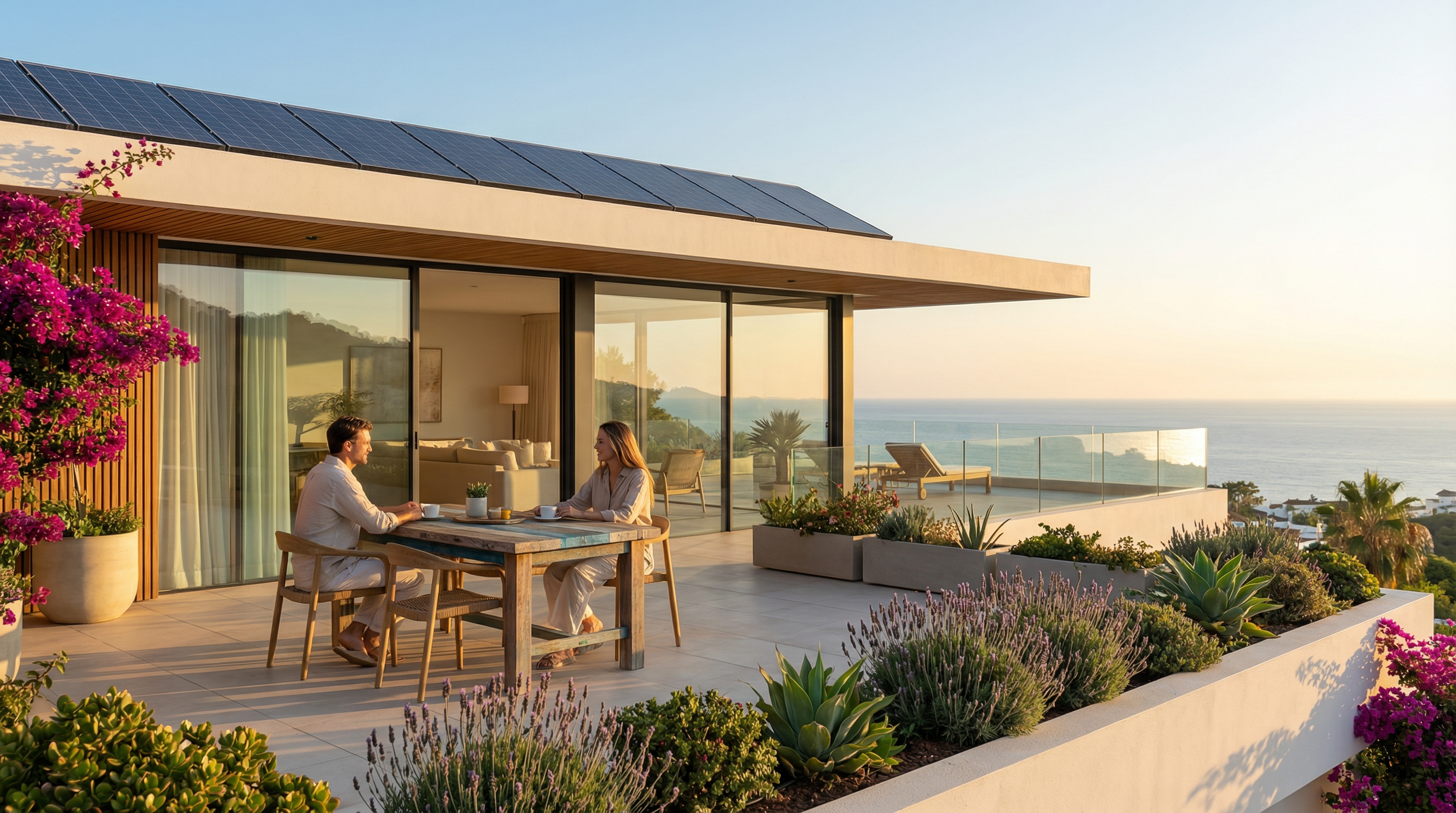
Solar panel installations rank second in buyer priorities, typically costing €8,000-15,000 for a 5kW residential system but delivering payback periods of 6-8 years through reduced electricity bills. Properties with existing solar installations save buyers both upfront costs and the 6-month installation timeline. Heat pump systems, costing €4,000-8,000 to install, reduce heating costs by 40-60% compared to traditional gas systems while meeting new construction efficiency mandates.
Certification Premiums Create Investment Opportunities
BREEAM and LEED certified properties add 5-8% to resale values while commanding 10-15% rental premiums in prime Costa del Sol locations (Green Building Council Spain 2025). Passivhaus certification, though rare in Spain with only 2,500 certified homes nationally, delivers the highest premiums at 12-18% above comparable properties due to energy consumption 90% below conventional builds.
Smart home technology integration costs €3,000-8,000 for comprehensive systems but increases property appeal to international buyers seeking modern efficiency. Water recycling systems, mandatory in new builds above 500m² from 2025, reduce municipal water bills by 30-40% annually. Properties with greywater recycling systems command premiums of €15,000-25,000 in water-scarce regions like Almería and Murcia.
Costa del Sol Leads Spanish Sustainability Market
The Costa del Sol demonstrates Spain's most advanced sustainable property market, with 35% of new builds in Marbella and Estepona incorporating solar-ready infrastructure compared to 18% national average (Colegio de Aparejadores Málaga 2025). Fuengirola's new sustainable development zones require BREEAM Very Good minimum certification, pushing construction costs to €1,800-2,200/m² but ensuring long-term value protection.
Málaga province offers the highest concentration of certified sustainable properties in Andalucía, with 1,200 BREEAM-certified homes and 180 LEED properties as of early 2025. Local regulations mandate solar-ready roofing on all new builds, while renovation grants of up to €18,000 per property (Plan de Recuperación EU funds) incentivize sustainable upgrades in existing homes.
Strategic Implementation for Sustainable Buyers
Buyers should budget an additional 1.5-2% of purchase price for specialized sustainability inspections, covering solar system efficiency, insulation performance, and certification compliance verification. Professional energy audits cost €400-800 but identify potential savings worth €200-500 annually in utility costs.
Financial planning must account for sustainable feature premiums: EPC A-rated properties cost 8-12% more initially but deliver superior rental yields of 6.5-7.2% versus 5.8-6.4% for conventional properties in comparable locations. Mortgage providers like Triodos Bank offer green mortgages with 0.1-0.25% rate reductions for certified sustainable properties, reducing financing costs over typical 20-year terms.
For personalized guidance on sustainable property features and their Costa del Sol market implications, consider consulting with Emma, our AI advisor, who can analyze specific certification requirements and long-term value projections for your investment strategy.
Official Sources
- Energy Performance Certificate (EPC) - Ministerio para la Transición Ecológica
- Official Spanish government information on energy performance certificates for buildings. - Ministerio para la Transicion Ecologica
