
AI summary
What hidden costs arise from blending heritage and modern designs? asks for a practical assessment of costs, documents, timing, risk and local Costa del Sol context. For international buyers, this is especially important for new-build homes, financing, legal checks and off-season use.
Practical comparison
| Factor | Why this matters | Control point |
|---|---|---|
| Costs | The purchase price is not the full budget. | Taxes, legal fees, bank, notary, registry and HOA. |
| Legal | Documents determine risk and timing. | Lawyer, permits, title deed and proof of payment. |
| New build | Off-plan purchases require extra checks. | Licence, bank guarantee, payment plan, handover and snagging. |
| Local context | Usage differs by buyer and season. | Flights, family visits, rental rules and quiet months. |
The Real Construction Premium for Heritage-Modern Blends
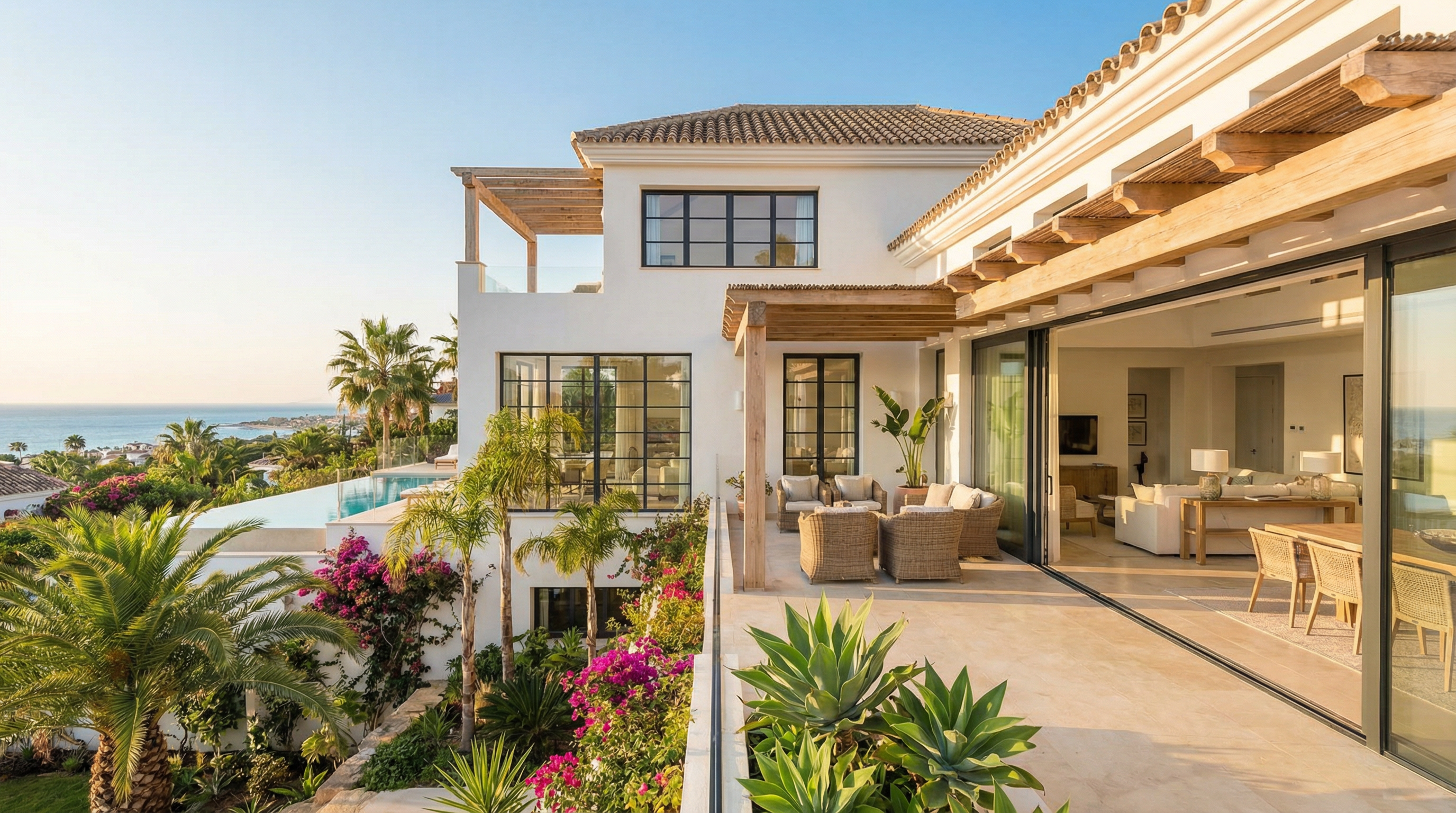
Combining Mediterranean architectural heritage with contemporary design elements on the Costa del Sol creates a construction cost premium of €150–400 per m² above standard new builds, according to 2025 contractor data. This premium stems from three primary cost drivers that buyers consistently underestimate.
Specialized architectural design work commands €120–180 per m² compared to €60–90 for standard residential plans (Colegio de Arquitectos de Málaga 2025). These bespoke designs require structural engineers to integrate traditional load-bearing elements like thick stone walls with modern expansive glass facades, often requiring custom steel reinforcement systems costing €80–120 per linear meter.
Heritage-compliant materials drive the largest cost escalation. Handcrafted terracotta tiles from traditional kilns cost €45–80 per m² versus €15–25 for standard ceramic alternatives. Authentic Andalusian ironwork for balconies and window grilles runs €180–350 per m², while mass-produced alternatives cost €60–120. Natural stone cladding matching historical precedents costs €85–180 per m² installed, compared to €35–65 for contemporary stone panels.
Hidden Labor and Installation Complexities
Skilled artisans capable of executing traditional Mediterranean craftsmanship command daily rates of €280–420 on the Costa del Sol, representing a 60–80% premium over standard construction labor at €175–235 per day (Confederación de Empresarios de Málaga 2025). These specialists are essential for techniques like lime-based stucco application, traditional tile laying patterns, and ornate plasterwork restoration.
Installation complexity multiplies when integrating smart home technology into heritage-inspired structures. Running fiber optic cables and sensor networks through thick stone walls requires specialized drilling equipment costing €150–200 per day rental, plus 40–60% additional installation time. Climate control systems must work around traditional building materials with poor thermal efficiency, often requiring oversized HVAC units costing €3,000–8,000 more than standard residential systems.
Waterproofing presents particular challenges where traditional materials meet modern glass installations. Specialized sealants and membrane systems cost €25–45 per linear meter, while standard applications run €8–15. Failed integration points frequently require remedial work costing €1,200–2,800 per incident.
Regulatory Hurdles and Approval Delays
Costa del Sol municipalities increasingly scrutinize heritage-modern blend projects, with planning approval timelines extending 20–40% beyond standard applications. Fuengirola's heritage committee requires additional documentation costing €800–1,500 to prepare, while Marbella's architectural review board charges supplementary fees of €1,200–2,400 for non-standard designs.
Archaeological surveys become mandatory when traditional foundation techniques are specified, adding €2,500–6,000 to pre-construction costs. Heritage impact assessments, required in designated cultural zones, cost €1,800–3,500 and can delay groundbreaking by 8–16 weeks.
Building code compliance proves complex when traditional construction methods must meet current safety standards. Fire-rated traditional timber treatments cost €35–55 per m² versus €12–18 for standard materials. Seismic reinforcement for heritage-style masonry adds €180–320 per m² in steel and concrete reinforcement.
Long-term Operational Cost Implications
Energy efficiency suffers significantly in heritage-modern blends without proper integration planning. Traditional thick stone walls without thermal breaks increase heating costs by 25–40% annually, typically adding €800–1,400 to yearly utility bills for a 200m² home. Single-glazed traditional windows, even when historically accurate, lose 60% more heat than modern alternatives, impacting HVAC operational costs.
Maintenance complexity creates ongoing expense escalation. Natural stone facades require specialized cleaning every 3–5 years at €15–25 per m², while modern materials need attention every 8–12 years at €8–12 per m². Traditional roof tiles require individual replacement at €12–18 per tile including labor, while modern alternatives cost €6–10.
Insurance premiums reflect increased replacement costs and complexity, typically running 15–25% higher than equivalent modern properties. Specialized craftsman availability for repairs creates premium labor rates during maintenance, often 40–70% above standard construction repair costs.
If you're considering a heritage-modern blend project, Emma can help analyze specific cost implications for your chosen location and design preferences, ensuring realistic budget planning from the start.
Official Sources
- building energy efficiency standards - Código Técnico de la Edificación
- Spanish housing market statistics - Instituto Nacional de Estadística
