
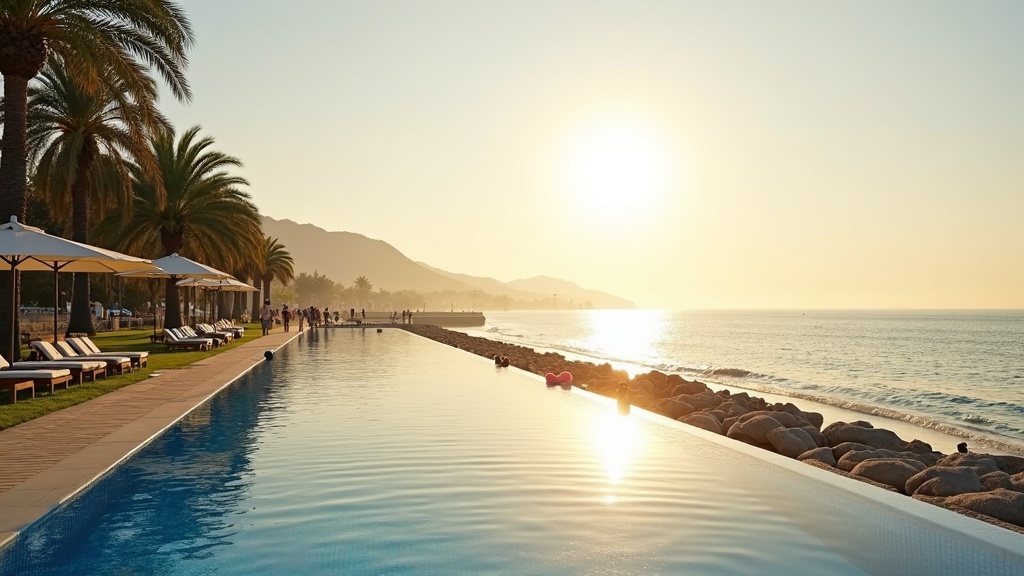
How Many Daily Sunshine Hours Can You Expect on the Costa del Sol?
The Costa del Sol truly lives up to its name, delivering an average of 8-9 sunshine hours per day throughout the year. This translates to over 320 sunny days annually according to AEMET meteorological data – meaning you'll wake up to clear skies more than 85% of the time.
Having worked as a property advisor here for over 15 years, I've witnessed firsthand how this exceptional sunshine record transforms lives. Clients from Northern Europe consistently tell me that the guaranteed daily sunshine was their primary motivation for purchasing property here. It's not just about warm weather – it's about accessing a lifestyle where outdoor living becomes the natural daily rhythm.
The seasonal variation follows a predictable pattern that savvy buyers learn to appreciate. Summer months (June-August) deliver peak performance with 11-12 hours of daily sunshine, perfect for extended beach days and evening terrace dining. Spring and autumn months (April-May, September-October) provide an ideal 8-10 hours daily, creating perfect conditions for golf, hiking, and outdoor socialising. Even winter months (November-March) maintain a remarkable 6-7 daily sunshine hours – a stark contrast to the grey Northern European winter that drives so many clients southward.
What makes these figures particularly reliable is their consistency year after year. Unlike other Mediterranean destinations where weather patterns can be more variable, the Costa del Sol's microclimate delivers dependable sunshine that you can genuinely plan your life around.
Why This Sunshine Guarantee Matters for International Property Buyers
For my clients, particularly those relocating from Scandinavia, Germany, and the UK, sunshine isn't merely a lifestyle preference – it's a health and wellness investment. The psychological and physical benefits of consistent daily sunshine exposure create compelling reasons beyond simple comfort.
Vitamin D synthesis occurs naturally with just 15-20 minutes of daily sun exposure, supporting bone health, immune function, and cellular repair processes. Many clients report noticeable improvements in energy levels, sleep patterns, and general wellbeing within months of relocating. The production of serotonin – our natural mood regulator – increases significantly with regular sunshine exposure, explaining why so many residents describe feeling more optimistic and energetic year-round.
The outdoor lifestyle possibilities multiply exponentially with guaranteed sunshine. Golf courses remain playable throughout winter months, beach walks become daily rituals rather than seasonal treats, and al fresco dining extends from March through November. Swimming pools see year-round use, terraces become genuine living spaces, and the social calendar expands to embrace outdoor entertaining in every season.
From an investment perspective, properties with optimal sun exposure command premium prices and stronger rental demand. South-facing and southwest-facing apartments with unobstructed views consistently outperform their north-facing counterparts in both capital appreciation and rental yields. The sunshine guarantee effectively underwrites your property's long-term value proposition.
Understanding the Costa del Sol's Unique Microclimate Advantage
The Costa del Sol's exceptional sunshine hours result from a remarkable geographical phenomenon that creates one of Europe's most stable microclimates. The Sierra Nevada mountain range to the north acts as a natural barrier, deflecting cold Atlantic weather systems and channelling them over the peaks rather than across the coastal plain.
This mountain barrier effect combines with the Mediterranean Sea's thermal regulation to create uniquely stable conditions. During winter months, the sea releases stored summer heat, maintaining mild coastal temperatures and extending sunny periods. In summer, the same thermal mass prevents excessive heat buildup, keeping conditions comfortable even during peak season.
Rainfall patterns demonstrate this microclimate's effectiveness clearly. While interior Andalusian cities experience significant winter precipitation, coastal areas from Nerja to Sotogrande benefit from the rain shadow effect. Annual precipitation averages just 500-600mm, concentrated primarily in brief November-February periods that rarely disrupt the daily sunshine quota.
The Malaga meteorological station records consistently demonstrate this advantage. Compared to Barcelona (2,400 annual sunshine hours) or Valencia (2,800 hours), the Costa del Sol achieves approximately 3,200 annual sunshine hours. This represents nearly 300 additional sunny days compared to Northern European capitals, where annual totals often fall below 1,500 hours.
Wind patterns further enhance the sunshine experience. The prevailing Levante (easterly) and Poniente (westerly) winds clear atmospheric humidity and maintain the crystal-clear skies that photographers and residents alike celebrate. These thermal winds also moderate temperatures, ensuring that abundant sunshine never becomes oppressive.
Maximising Your Sunshine Investment: Property Selection Strategy
Securing maximum sunshine hours requires strategic property selection beyond simply choosing the Costa del Sol as your destination. Orientation, elevation, and local topography dramatically influence your daily sunshine exposure, particularly during the crucial winter months when Northern European buyers seek their warmest refuge.
South-facing and southwest-facing properties capture optimal sunshine from dawn through sunset. Southwest orientation proves especially valuable, delivering afternoon and early evening sun that extends outdoor living well into winter evenings. I regularly advise clients that a southwest-facing terrace adds measurable value to both lifestyle enjoyment and resale potential.
Elevation considerations prove equally crucial. Properties positioned on gentle slopes or elevated positions typically receive unobstructed sunshine throughout the day. However, excessive elevation can reduce temperatures, while valley positions may experience morning shadow delays. The sweet spot often lies at 50-150 metres above sea level, providing optimal sunshine capture without temperature penalties.
Surrounding development patterns require careful analysis. Future construction plans, neighbouring building heights, and natural landscape features all influence long-term sunshine access. I maintain detailed knowledge of municipal development plans across the Costa del Sol, helping clients avoid properties that might face future shading issues.
Architectural features deserve equal attention. Deep terraces, strategic pergolas, and retractable awning systems allow residents to optimise sunshine exposure throughout changing seasons. Properties with multiple outdoor spaces – perhaps a morning breakfast terrace and an evening dining area – provide maximum flexibility for sunshine enjoyment.
Pool positioning often determines daily sunshine patterns for the entire property. South-facing pools receive maximum solar heating and extended swimming seasons, while strategic landscaping can create sun-trap areas that capture warmth even on cooler days. These details distinguish exceptional sunshine properties from merely adequate ones.
Energy efficiency considerations complement sunshine optimisation. Proper insulation, high-performance glazing, and solar panel integration help convert abundant sunshine into reduced utility costs. Many newer developments incorporate passive solar design principles, using sunshine as a natural heating and lighting source while minimising summer cooling requirements.
For guidance on maximising your sunshine investment, our AI advisor Emma can help match your specific sunshine requirements with suitable properties across the Costa del Sol. Her knowledge base includes detailed sunshine analysis for thousands of properties, helping you make informed decisions about this crucial lifestyle factor.
Buyer decision matrix
| Factor | Why it matters | What buyers should verify |
|---|---|---|
| Documents | Wrong sequencing can delay the purchase. | NIE, lawyer, bank account, tax budget and payment evidence. |
| Costs | The asking price is not the full budget. | Taxes, notary, registry, lawyer, bank, insurance and community fees. |
| New build | Off-plan payments need protection. | Licence stage, bank guarantees, payment plan and handover terms. |
Local buyer context
A safe buying decision connects documents, banking, tax, legal review and local practice before reservation.
A buyer comparing London, Belfast, Dublin, Manchester or Amsterdam routes usually weighs flight rhythm, family visits, remote work and quieter-month practicality.
For new builds, connect the topic with licences, payment plan, materials, shared facilities, handover and aftercare.
New-build focus: For new builds, connect the topic with licences, payment plan, materials, shared facilities, handover and aftercare.
