
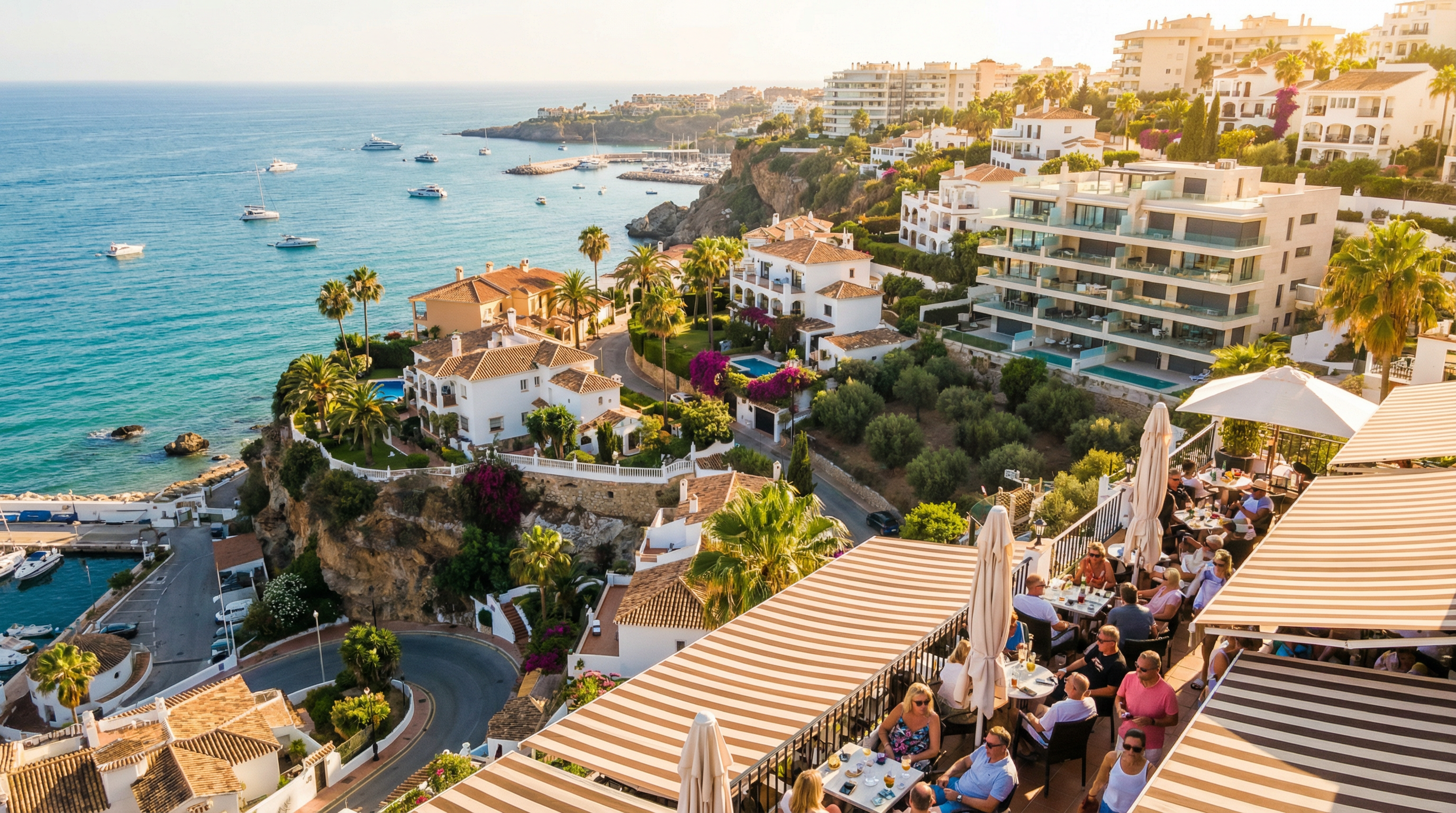
We’re writing this from a café in Puerto Banús, where we’ve helped hundreds of families buy property in Costa del Sol. Beyond the beaches and golf, this market rests on real economic bedrock. If you’re considering a second home or first investment in Spain, understanding those fundamentals will help you move with confidence.
What really drives Costa del Sol property value?
In our experience, four pillars underpin the region’s long-term stability: tourism, infrastructure, jobs, and international demand. When these move in sync, you get reliable occupancy, resilient pricing, and a broad buyer pool. That’s why Costa del Sol remains a top choice to buy property for a second home and smart investment.
The four pillars at a glance
First, year-round tourism supports short stays in winter and family holidays in summer, smoothing rental seasonality. Málaga–Costa del Sol Airport handled, connecting over 130 destinations . Second, infrastructure—from the AP-7 to high-speed AVE to Málaga’s port—keeps people and capital flowing.
- Growing knowledge jobs at Málaga Tech Park (PTA) and digital hubs add salaried, year-round residents .
- Diversified international demand (northern Europe, Middle East, North America) keeps liquidity broad-based .
- Tourism volume and nightly stays underpin occupancy across Marbella, Estepona, Mijas, Fuengirola, and Benalmádena .
Why this matters to investors and first-time second-home buyers
For investors, these fundamentals translate into dependable rental demand and exits. For first-time second-home buyers, they mean your lifestyle purchase sits on an economy that helps preserve value. We call it the “sunshine + substance” equation.
Benefits you can feel and measure
Resilience is the first benefit—flight connectivity and diversified buyers soften shocks. Liquidity is the second: from €300k apartments to €5m villas, you can find buyers in most market cycles. Finally, yield: holiday lets can produce strong gross yields when properly licensed and managed .
- Consistent winter occupancy from golfers and remote workers diversifies beyond summer tourism.
- High-quality amenities (schools, clinics, dining) attract long-stay tenants, stabilizing cash flow.
- Transparent purchase process and notarial oversight reduce transaction risk .
How to buy property in Costa del Sol with confidence
We’ve guided more than 500 international families through this process. The steps are clear, and predictable timelines help you plan. Here’s how to move from intention to ownership efficiently.
Seven steps, from plan to keys
1) Define your brief. Decide between a pure investment, a second home with some rental, or a primary relocation. Align budget, preferred areas, property type, and rental strategy. Use a plan-on-a-page template to stay focused.
- Contrast new-build and resale options .
- Map your must-haves: walking distance to beach, sea views, parking, terrace size.
2) Get your numbers right early. Non-residents typically secure 60–70% LTV mortgages, with rates tied to Euribor plus a bank margin . Secure a decision-in-principle and factor all costs at the outset.
- Explore bank financing and brokers .
- Budget for purchase taxes and fees .
3) Obtain your NIE and open a Spanish account. You’ll need an NIE to purchase and for utilities. Many clients complete this within days with proper appointments .
- Sequence admin with viewings to save time .
4) Curated viewings. We pre-vet communities, developer track records, and legal status before you step on a terrace. Plan 6–10 targeted viewings over two days; video tours help refine the list.
- Compare micro-locations: road noise, sun path, and privacy at different times of day.
5) Due diligence and reservation. Once you choose, we secure a reservation contract while your lawyer confirms planning status, debts, and community rules. This protects you while the private purchase contract is prepared.
- Always use an independent lawyer and request a legal pack upfront .
6) Completion at notary and registration. On completion day, funds clear, the public deed is signed, and utilities/insurance are arranged. The Land Registry inscription follows soon after .
- For new-builds, add snagging and bank guarantee checks .
7) Rental setup or move-in. If you will rent, ensure the property meets licensing standards and community rules. If it’s your second home, we’ll help with furniture packages and smart-home setup.
- Understand holiday-let licensing and RTA registration .
What does “economic stability” look like on the ground?
We track a basket of indicators to gauge the health of the market beyond headlines. You can do the same to time your buy and calibrate strategy. It’s a practical way to turn macro noise into actionable signals.
Indicators worth watching
Air and hotel demand. Passenger growth at AGP and hotel occupancy trends lead short-term rental demand by a quarter . Workforce and wage trends. Employment at Málaga Tech Park and new multinational arrivals support long-let demand .
- Foreign-buyer share. Registration data shows when international demand is broadening or narrowing .
- Inflation and rates. CPI and Euribor inform financing costs and buyer affordability .
- New-build pipeline. Permits and completions indicate future supply in key municipalities .
Costs, taxes, and finance: plan your numbers
Clarity on costs removes stress from the process. Andalucía maintains competitive purchase taxes compared with many European peers, and the structure is straightforward once you see it laid out.
Purchase costs: resale vs. new-build
Resale homes. In Andalucía, transfer tax (ITP) is a flat 7% on the purchase price, plus notary, registry, and legal fees (often 1.5–2%) . New-builds. VAT (IVA) is 10% for residential plus stamp duty (AJD), typically around 1.2% in Andalucía, plus fees .
- Mortgages. Bank arrangement fees, valuation, and mortgage stamp duty may apply depending on structure .
- Ongoing costs. IBI property tax, community fees, home insurance, and waste charges should be modeled in your yield .
- Licensing. Holiday-let registration is mandatory to rent short term in Andalucía .
Area snapshots: Marbella, Estepona, Fuengirola, Benalmádena, Mijas
Each municipality has its own rhythm, buyer profile, and value drivers. Below are quick sketches from our recent transactions and on-the-ground work. Use them as starting points for your shortlist.
Buyer profiles and price guideposts
Marbella. Flagship amenities and international schools; strong liquidity in prime and sub-prime. Quality apartments commonly trade in the €5,000–€8,500/m² range in top micro-locations, with wider town averages lower, depending on age and condition. Our observed ranges reflect current asking and achieved prices in 2024.
- Estepona. Rapidly improving promenade and new-build stock; quality stock around €3,500–€5,500/m² near the coast; Golf Valley provides value for larger formats.
- Fuengirola. Transit-friendly and lively year-round; modern remodels in the €3,000–€4,800/m² corridor; strong long-let demand due to transport links.
- Benalmádena. Families and Scandinavians favor the marina and Higuerón area; typical €2,800–€4,500/m² for newer homes with amenities.
- Mijas (Costa & Pueblo). Villas with views and townhouse communities; apartments often €2,600–€4,200/m² depending on proximity and spec.
Risk management: de-risk your purchase and your yield
Good investments are built in the buying stage. We focus on controllables—legal clarity, build quality, and rental suitability—to reduce surprises and protect your downside.
Due diligence and operational safeguards
Title and planning. Your lawyer should verify land-registry status, planning compliance, debts, and community rules before you sign a private contract . Short-term rentals. Confirm community statutes allow holiday letting before you buy .
- Technical checks. For new-builds, request bank guarantees and snag thoroughly; for resales, commission a survey where appropriate .
- Energy and safety. Ensure Energy Performance Certificate (EPC) and habitability are in order .
- Insurance and management. Model management fees, cleaning, and a reserve for capex; the right manager can preserve ratings and ADR.
2024–2025 signals: what we’re seeing now
From Marbella’s Golden Mile to Benalmádena’s hillside resorts, the pattern is consistent: well-presented, fairly priced homes move quickly; compromised assets linger. The buyer mix remains international, with steady European demand and new interest from North America.
Trendlines to watch this year
Rates and affordability. Easing inflation reduces pressure on mortgage costs, supporting financed buyers . Supply. Quality new-builds are absorbed steadily; secondary resales compete on renovation and energy performance .
- Tourism momentum. Málaga Airport seat capacity and hotel ADRs hint at another buoyant year for rentals .
- Foreign buyer share. Registry data indicates Andalucía’s sustained appeal to non-residents .
Buyer decision matrix
| Factor | Why it matters | What buyers should verify |
|---|---|---|
| Everyday use | The home must work outside holiday weeks. | Access, services, noise, parking, running costs and year-round comfort. |
| Resale | Practical use supports future demand. | Location, maintenance, rules, energy and local activity. |
| New build | Specifications shape comfort and costs. | Orientation, shade, ventilation, shared facilities, handover and aftercare. |
Local buyer context
Investment value needs realistic use, documented costs, demand, rules and a clear exit route.
A buyer comparing London, Belfast, Dublin, Manchester or Amsterdam routes usually weighs flight rhythm, family visits, remote work and quieter-month practicality.
For new builds, connect the topic with licences, payment plan, materials, shared facilities, handover and aftercare.
New-build focus: For new builds, connect the topic with licences, payment plan, materials, shared facilities, handover and aftercare.
