
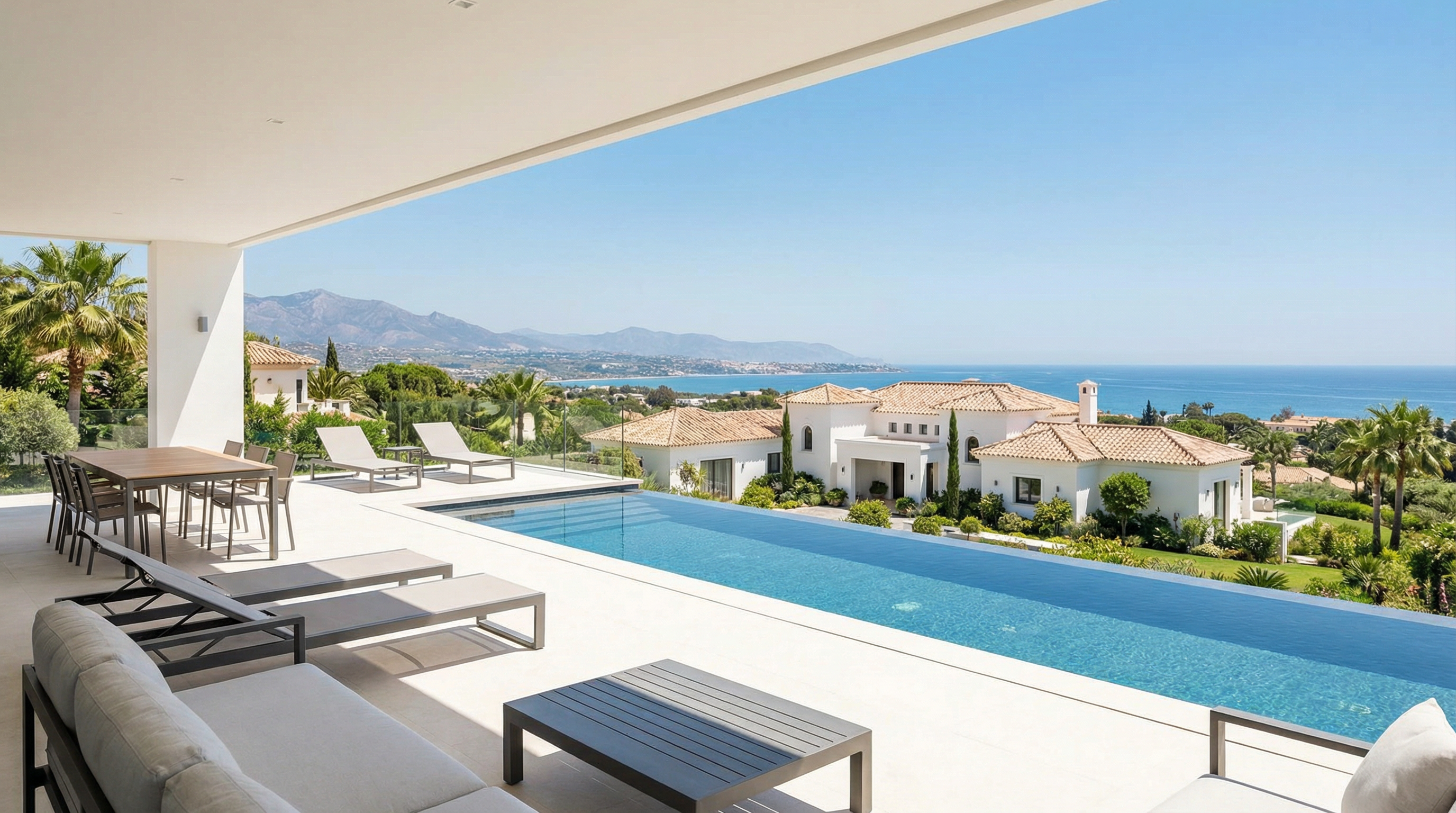
We’re often asked—usually over a café cortado in Puerto Banús—whether construction quality in Spain matches Northern Europe. The short answer: it’s different, not worse. Southern design responds to heat, salt air, and strong sun. If you know what to check, Costa del Sol new builds can meet excellent standards in 2026.
Is construction quality in Spain lower than in Northern Europe?
Spain builds under the national, which sets structural, fire, energy, acoustic, and health standards comparable in scope to Northern Europe, but adapted to Mediterranean conditions . Differences you’ll notice come from climate, materials, and historical practice—not lack of regulation.
In our experience guiding more than 500 buyers, the best Costa del Sol developers match or exceed expectations when supervision is strong and specifications are clear. Weaknesses typically show up in moisture management, acoustic detailing, and workmanship consistency rather than in core structural safety.
Key differences in 2026: climate-led design, materials, and detailing
Here’s how Spain—and especially Andalucía—tends to differ from the North:
- Structure: Reinforced concrete frames and slabs are standard; seismic detailing applies in Málaga province zones .
- Envelopes: Masonry or aerated blocks with external render or SATE/ETICS; insulation levels rising with recent CTE HE updates .
- Windows: Double glazing with thermal breaks is common; triple glazing appears at the luxury end, with solar-control glass to limit summer gains.
- HVAC: Aerothermal (air-to-water heat pumps) now prevalent; underfloor heating/cooling and fan-coils in premium units.
- Ventilation: Natural and demand-controlled systems are common; full MVHR appears mainly in high-spec projects.
- Acoustics: Spanish DB-HR sets minimums; Northern norms often demand stricter impact-noise control .
- Waterproofing: Flat roofs and terraces require precise falls, membranes, and detailing—this is where snag lists often grow.
What we observe on the Costa del Sol today
Between 2024–2026, we’ve seen clear upgrades: better insulation packages, aerothermal as standard, PV pre-installation, EV-ready garages, and improved window quality. The most frequent handover snags remain terrace falls and drainage, shower waterproofing, acoustic flanking at ducts, and joinery alignment—fixable when caught early with a proper snag.
Why build quality matters for you (comfort, costs, and resale)
High-quality construction pays you back in comfort, lower running costs, and long-term value. In the Costa del Sol climate, correct solar shading, airtightness, and insulation reduce summer heat gains and winter heat loss—important for buyers used to Northern efficiency standards.
From a resale perspective, documented quality, clean snag reports, and top energy ratings command premiums. We consistently see buyers paying more for well-built homes with clear technical paperwork and proven performance.
The 10–3–1 warranty rule, explained
Spanish law provides graduated protection for new residential buildings under the Ley de Ordenación de la Edificación (LOE): 10 years for structural defects (structural safety), 3 years for habitability issues (moisture, sanitation), and 1 year for finishing defects . Developers must carry the 10-year structural insurance (Seguro Decenal), typically backed by a Technical Control Body (OCT) .
- Documentation you should see: Seguro Decenal policy, OCT reports, and the Libro del Edificio (building manual) on delivery.
- Use the 1-year period for thorough snagging and workmanship corrections.
How Spanish building standards are regulated—and the paper trail to request
Spain’s CTE code governs: DB-SE (structural safety), DB-SI (fire safety), DB-HS (health and moisture), DB-HE (energy), DB-HR (acoustics). Municipalities issue works licenses and first occupancy licenses (LPO) after compliance checks . Andalucía’s town halls follow regional procedures for LPO issuance based on final completion certificates .
From a buyer’s standpoint, your best assurance is a complete and verifiable documentation set. Ask for it early, not at handover.
The essential documents pack for new-builds
Request these items before or at completion:
- Licencia de Obra (building permit) and Proyecto de Ejecución visado (approved executive project).
- Estudio Geotécnico (geotechnical report) defining foundation design .
- Certificado Final de Obra (CFO) signed by Director de Obra and Director de Ejecución.
- Acta de Recepción (handover record) and Libro del Edificio.
- Licencia de Primera Ocupación/LPO (first occupancy license) from the Ayuntamiento .
- Seguro Decenal policy and OCT reports (if applicable) .
- CEE Energy Certificate under RD 390/2021 .
- As-built drawings and MEP manuals; warranties for equipment (aerothermal, elevators, PV inverters).
Local nuances on the Costa del Sol
Marbella, Estepona, Mijas, Benalmádena, and Fuengirola share the same national code, but processing of LPO and municipal site inspections differ by town hall. Timelines and paperwork formatting vary; compliance criteria do not. Plan your completion around local lead times to avoid stress.
A step-by-step due diligence checklist to assess build quality
After years of handovers, we follow a consistent, evidence-based method that works across projects from €350,000 apartments to €4M villas. It protects your budget, time, and peace of mind.
Use this process for any Costa del Sol new build in 2026:
1) Desk review before site visit
Confirm permits, geotechnical study, executive project, insurance, and LPO status. Cross-check specifications (memoria de calidades) against brand/model data sheets. Flag any substitutions for written approval.
- Ask for DB-HE calculations, thermal transmittance (U-values), and acoustic design notes .
- Verify balcony/terrace build-ups and falls drawings—key for moisture control.
2) Independent technical inspection
Engage a chartered surveyor/architect to perform a pre-completion snag with moisture meter, thermal camera, and levels. We coordinate this frequently for clients and find it invaluable for objective reporting .
- Schedule 2–3 visits: pre-snag, re-inspection, and final verification.
- Include garage/communal areas, roofs, plant rooms, and façades.
3) Envelope and moisture control
Inspect roof and terrace falls (target ≥1.5–2%), membrane integrity, upstands, and drainage points. Check shower/bathroom waterproofing continuity and balcony door thresholds. Look for efflorescence or damp at slab edges and planters.
- Confirm drip edges, expansion joints, and parapet cappings.
- Review planter details—root barriers and drains are often overlooked.
4) Openings and glazing quality
Confirm frames with thermal breaks, correct gaskets, and setting blocks. Test every window and door for smooth operation and locking. Look for sealant continuity and weep holes. In high-exposure front-lines, favor marine-grade hardware.
- Seaside properties: specify stainless A4 fasteners to resist corrosion.
- Verify SHGC/solar-control glass to prevent summer overheating.
5) Acoustics and services
Impact noise comes through structure; airborne noise leaks via gaps and flanking routes. Check floor underlays, party wall double leaves with mineral wool, and penetrations around ducts and sockets. Run all plumbing, check pressure/flow, and observe for hammering or leaks.
- Request commissioning reports for aerothermal, ventilation, and lift systems.
- Confirm acoustic door seals to stairs and garages in apartments.
6) Energy and comfort performance
Ask for DB-HE compliance summary and CEE rating. Inspect insulation continuity at beam edges and lintels to reduce thermal bridges. Verify room-by-room controls for underfloor heating/cooling where installed.
- Confirm PV pre-installation or actual PV capacity where marketed.
- Check shading: pergolas, louvres, or deep terraces on West/South façades.
7) Safety and compliance
Verify balustrade heights and fixings, fire doors and closers, garage ventilation, and CO detectors. In villas, review pool safety and electrical bonding. In apartments, confirm evacuation routes align with DB-SI .
- Collect the Acta de Recepción and user manuals on handover.
- Ensure your snag list forms part of the handover documentation.
8) Legal and timeline safeguards
For off-plan, match the delivery date and quality spec in the contract. Bank guarantees protect deposits, not finishes; aim for a contractual snagging process and retention or escrow where feasible. Seek legal advice early .
- Plan a realistic 8–12 week window between LPO and your completion for snags and paperwork.
- Coordinate mortgage valuation timing if financing .
Common issues we flag early—and how to prevent defects
Patterns repeat. Stopping defects before you take keys saves time and future community disputes. Here are the most frequent—and the fixes we push for.
Moisture and waterproofing
Terrace ponding, inadequate upstands, and missing secondary drains are top culprits. We require water tests on flat roofs/terraces and insist on correcting falls and drain placements before tiling. Shower wet zones must have continuous membranes and flood tests.
- Specify inverted roof build-ups with XPS over membranes when possible.
- Check planters: separate waterproofing and overflow scuppers.
Acoustics and mechanical noise
Flanking via duct shafts and rigid connections at fan-coils or pumps cause hums and impact noise. We request resilient mounts, acoustic collars, and sealed penetrations. In penthouses, isolate roof plant equipment from the slab.
- Ask for post-completion acoustic test reports where available.
- Verify underlay continuity at door thresholds.
Coastal corrosive environment
Salt-laden air attacks fixings, balustrades, and exposed rebars at cracked edges. We recommend A4 stainless steel hardware, proper concrete cover, and anti-carbonation coatings for exposed structures in front-line zones.
- Inspect balconies for hairline cracks and rust staining—early warning signs.
- Specify marine-grade finishes within 500–800 m of the shoreline.
Finishes and tolerances
Misaligned carpentry, tile lippage, silicone gaps, and scratched glazing are common but easy to resolve pre-handover. We use tolerance guides and list every room with photos so developers can rectify efficiently.
- Protect finished floors during ongoing works to avoid rework.
- Sign off room by room after corrections, not all at once.
Contractual quality assurance
Your best leverage is before completion. Tie the memoria de calidades to named brands and models, secure sample approvals, and include a structured snagging and rectification timeline in writing. For complex villas, consider a clerk-of-works presence during construction.
- Keep an issues log with dates and agreed fixes.
- Escalate via your lawyer if deadlines slip materially.
2026 market insights: where quality is trending on the Costa del Sol
As of Q1 2026, we see three clear shifts. First, energy: aerothermal is standard across reputable schemes; PV pre-install or panels appear on many rooftops. Second, acoustics: more developers now exceed DB-HR in party walls and floors. Third, industrialized elements (prefab bathrooms/façade panels) improve consistency.
Pricing reflects specification. In Marbella/Benahavís prime, high-tier acoustic packages, triple glazing in select units, and extensive shading are more common. In Estepona/Mijas mid-market, many projects strike a good balance—double glazing with low-e coatings, improved insulation, and reliable aerothermal systems—while keeping prices accessible.
What your budget buys in quality terms
- €350k–€650k apartments: solid CTE compliance, double glazing with thermal breaks, aerothermal, acceptable acoustics; focus your due diligence on terraces, bathrooms, and duct flanking.
- €650k–€1.5M: stronger acoustic build-ups, upgraded façades (SATE/ETICS), better shading, underfloor heating/cooling; expect documented commissioning.
- €1.5M–€4M+ villas: bespoke detailing, MVHR in some, full smart controls, higher-grade membranes and marine hardware; insist on full technical packs and staged inspections.
Buyer decision matrix
| Factor | Why it matters | What buyers should verify |
|---|---|---|
| Documents | Wrong sequencing can delay the purchase. | NIE, lawyer, bank account, tax budget and payment evidence. |
| Costs | The asking price is not the full budget. | Taxes, notary, registry, lawyer, bank, insurance and community fees. |
| New build | Off-plan payments need protection. | Licence stage, bank guarantees, payment plan and handover terms. |
Local buyer context
A safe buying decision connects documents, banking, tax, legal review and local practice before reservation.
A buyer comparing London, Belfast, Dublin, Manchester or Amsterdam routes usually weighs flight rhythm, family visits, remote work and quieter-month practicality.
For new builds, connect the topic with licences, payment plan, materials, shared facilities, handover and aftercare.
New-build focus: For new builds, connect the topic with licences, payment plan, materials, shared facilities, handover and aftercare.
