
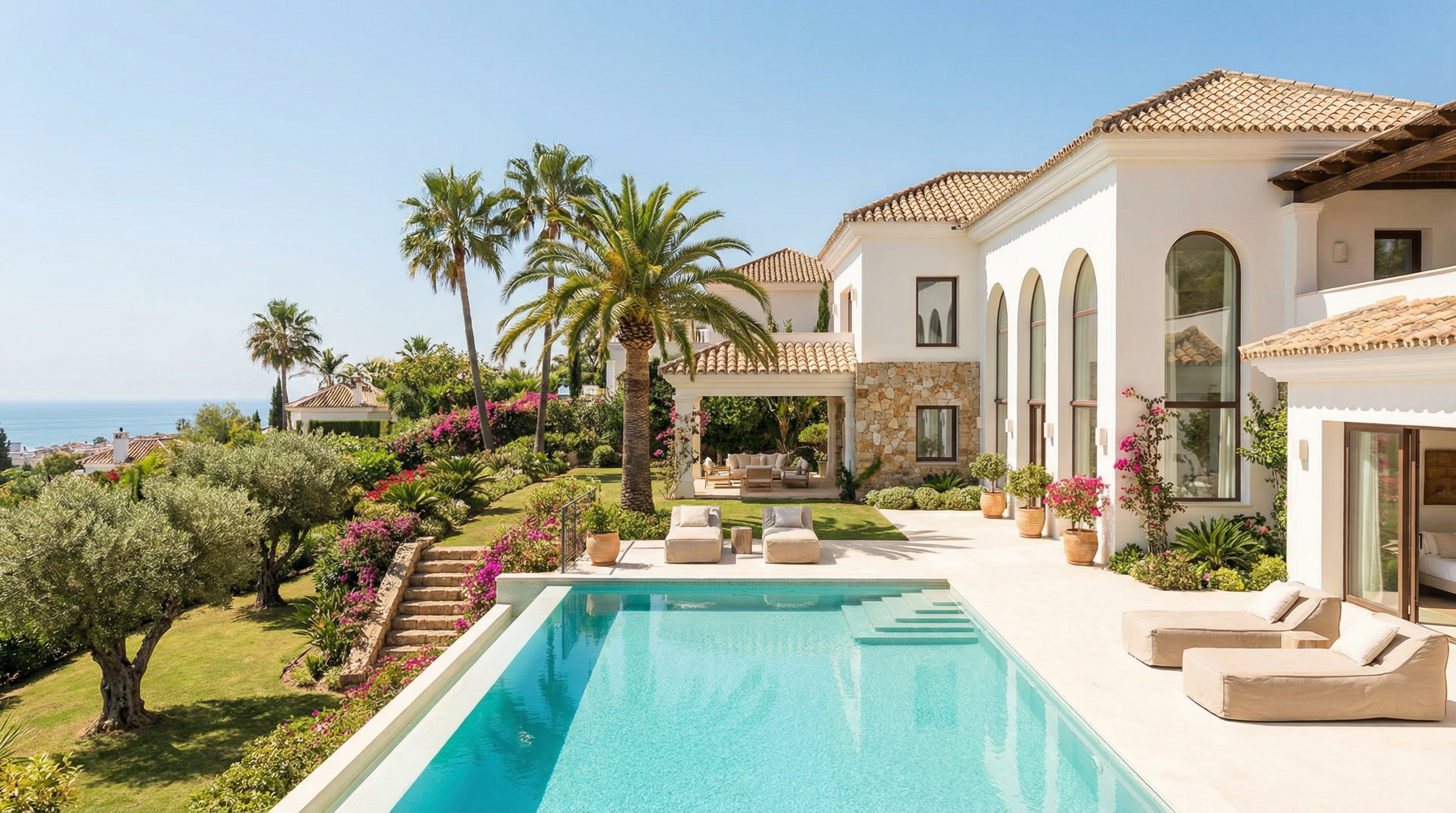
We’re writing this from a sunny table in Puerto Banús, where we’ve helped hundreds of international families buy with confidence. You’ve likely read headlines about droughts and heat. Here’s the calm truth: the Costa del Sol remains highly livable, but water scarcity and climate change must be part of your buying checklist. Done right, resilience improves comfort and protects long-term value.
Is water scarcity a real risk on the Costa del Sol in 2026?
Short answer: yes, but it’s uneven by area and increasingly mitigated by new infrastructure. Malaga province faced multi-year droughts with reservoir lows in recent cycles; restrictions varied by municipality and season. In parallel, capacity from desalination, reclaimed water for golf and landscaping, and emergency pipelines is expanding in 2025–2026 to buffer the network .
We advise clients to check the specific water source mix for their urbanisation. Coastal belts tied into regional networks (Acosol) with desalination and tertiary treatment are more robust than rural wells.In our experience, communities with storage tanks, pressure management, and drought-tolerant landscaping rode out recent restrictions with minimal disruption .
Quick facts you should know in 2026
Before you buy, ask for hard facts and written confirmations:
- 1) Recent drought cycles brought reservoir levels to stressed thresholds; responses included temporary pool-filling limits and irrigation cuts .
- 2) The Marbella desalination plant has undergone upgrades; additional capacity and new projects are scheduled to reinforce supply corridors in 2025–2027 .
- 3) Reclaimed water now supports many golf courses and public green areas, reducing pressure on potable supply .
- 4) Municipal rules differ. Always verify current local ordinances for pools, gardens, and community-use water .
How does climate change affect property and livability in Southern Spain?
Expect more heatwaves, irregular rainfall, and occasional intense downpours. For properties, that means higher cooling demand, potential wildfire exposure in certain hillsides, and localized flood risk in low-lying zones. The good news: design, materials, and orientation can offset most daily comfort issues .
We guide buyers to understand microclimates. Sea breezes moderate coastal neighborhoods, while sheltered valleys can feel warmer. A well-designed apartment in Marbella’s Golden Mile can be more comfortable than a poorly insulated villa inland—even at the same budget. Build for shade, airflow, and water efficiency, and you’ll feel the difference.
Microclimates: coast versus hills—what to weigh
Use these practical filters before shortlisting:
- 1) Coastal belts (Marbella, Estepona, Benalmádena, Fuengirola) enjoy cooling sea influence; check cross-ventilation and shading to reduce AC use.
- 2) Hill zones (La Quinta, Elviria Hills, Mijas Pueblo) offer views but may face higher wildfire exposure—confirm clearance buffers and hydrant coverage .
- 3) Check historical surface-water run-off patterns; lower ground near arroyos needs flood mapping and drainage verification .
What makes a Costa del Sol home climate-resilient?
Climate-resilient real estate means comfort today and liquidity tomorrow. We look for efficient building envelopes, smart water systems, and community-scale infrastructure. Solar-ready roofs, dual plumbing for greywater reuse, and drought-aware landscaping all lower running costs and raise buyer confidence. These features increasingly influence resale and rental performance.
Developers are moving fast. New builds now promote EPC ratings, water-saving fixtures, and insulation standards under Spain’s building code. In resales, upgrades like thermal glazing and smart irrigation deliver outsized benefits at moderate cost. A home that stays cool, uses less water, and carries stable insurance is a safer long-term asset .
Top 10 future-proof features to prioritise
Use this checklist during viewings:
- 1) Proven water supply: connection to regional network (Acosol) plus on-site storage/pressure systems .
- 2) Desalination/reclaimed-water access at community level for common areas and golf.
- 3) Building envelope: external insulation (SATE), double/triple glazing, low-solar-gain glass.
- 4) Cross-ventilation, deep overhangs, and shutters to cut cooling loads.
- 5) Efficient systems: heat pumps, variable-speed pool pumps, smart thermostats.
- 6) Water efficiency: dual-flush WCs, aerators, leak sensors, sub-metering.
- 7) Landscaping: native, drought-tolerant species; zoned drip irrigation with soil moisture sensors.
- 8) Roof readiness: solar PV/thermal potential; conduit pre-installation.
- 9) Fire-wise design in hillside areas: cleared perimeters, ember-resistant vents, hydrant proximity.
- 10) Verified drainage: French drains, backflow valves, and well-graded external surfaces.
Step-by-step: How to evaluate a property's water and climate resilience before you buy
We’ve developed a due diligence flow that saves time and avoids surprises. Most steps run in parallel with legal checks and surveys. For resales, you can complete this in 2–3 weeks; for off-plan, you’ll confirm specs and warranties before signing the private contract.
Bring your lawyer and a technical surveyor into the process early. Ask vendors and communities for written confirmations. Tie resilience into price negotiations and post-completion upgrade plans. This is how you de-risk and future-proof ownership in a calm, professional way .
Your 9-point buyer due diligence
Follow these steps and keep a written record:
- 1) Map supply: who provides potable water, what redundancy exists, and any historic restrictions in the community minutes .
- 2) Inspect infrastructure: storage tanks, pressure pumps, filtration, irrigation controllers; request maintenance logs.
- 3) Verify community rules: pool use under drought, landscaping standards, and reclaimed-water policies .
- 4) Assess the envelope: insulation, glazing, shading; obtain EPC and HVAC age/SEER ratings .
- 5) Check drainage: gutters, slope, sump pumps; ask about any past damp or flood claims.
- 6) Wildfire review: perimeter clearance, materials, hydrant distances; consult municipal plans .
- 7) Insurance quotes: obtain two premium quotes and confirm Consorcio coverage for extraordinary risks .
- 8) Budget upgrades: get contractor quotes for water-saving and cooling-efficiency improvements .
- 9) Finance and exit: confirm lender insurance requirements and resale expectations for EPC/water features .
Costs, insurance, and legal context you should know in 2026
Budgeting is where resilience becomes real. Water tariffs differ by municipality and consumption tier. Communities with recycled irrigation and smart control often spend less per home over time. During official drought phases, rules may limit non-essential use like garden watering or pool refills—verify current ordinances before completion .
Insurance remains broadly available. Premiums may reflect wildfire or flood exposure, but Spain’s Consorcio backstop covers extraordinary events once a private policy is in force. Lenders typically require all-risk cover, and some request minimum EPC levels for new-build mortgages—a trend to watch as EU rules evolve .
Budgeting guide with 2026 ballpark figures
Based on quotes and invoices we’ve seen across Marbella, Estepona, Fuengirola, Benalmádena, and Mijas in Q1 2026:
- 1) Water bills: €25–€70/month for efficient apartments; €60–€180/month for villas with careful irrigation; spiky use costs more in tiered systems.
- 2) Community fees: €120–€450/month typical; large amenities or extensive gardens trend higher .
- 3) Storage tank + booster: €5,000–€12,000 installed, capacity and access dependent.
- 4) Greywater reuse (showers/basins to garden): €3,000–€10,000; best in villas or ground-floor units.
- 5) Smart irrigation + native landscaping retrofit: €2,500–€15,000 depending on plot size.
- 6) Insulation/glazing upgrade: €6,000–€30,000; higher for large villas.
- 7) 5–7 kW solar PV with battery-ready inverter: €7,000–€14,000; thermal solar for DHW €2,000–€4,000.
- 8) Home insurance: €250–€1,000/year apartment; €600–€2,500/year villa; wildfire/flood zones trend higher .
Market insights: areas, developers, and infrastructure projects improving resilience
As of Q1 2026, we see a clear premium for efficient homes with verified water resilience. Buyers ask early about supply sources, community rules, and EPC ratings. New developments in Marbella and Estepona are leaning into reclaimed water for landscaping, efficient HVAC, and solar-ready roofing. Municipal upgrades continue around the western Costa del Sol corridor .
On pricing, we see wide bands by product and micro-location: Marbella prime asks can exceed €6,000–€12,000/m², Estepona €3,500–€7,000/m², Benalmádena €3,200–€5,500/m², Fuengirola €3,000–€5,000/m², and Mijas €2,800–€5,000/m². Resilient features help properties sell faster and negotiate tighter spreads in all segments, especially in lock-up-and-leave communities.
Where we see resilience improving fastest
Consider these signals as you shortlist areas :
- 1) Marbella–San Pedro–Benahavís: desal tie-ins, high-spec new builds, strong community management standards .
- 2) Estepona West: newer urbanisations with native landscaping and efficient systems.
- 3) Benalmádena–Fuengirola: compact living, good public services, reclaimed-water landscaping in many zones.
- 4) Mijas Costa: value-for-money resales; budget to retrofit for water and cooling efficiency.
Buyer decision matrix
| Factor | Why it matters | What buyers should verify |
|---|---|---|
| Documents | Wrong sequencing can delay the purchase. | NIE, lawyer, bank account, tax budget and payment evidence. |
| Costs | The asking price is not the full budget. | Taxes, notary, registry, lawyer, bank, insurance and community fees. |
| New build | Off-plan payments need protection. | Licence stage, bank guarantees, payment plan and handover terms. |
Local buyer context
A safe buying decision connects documents, banking, tax, legal review and local practice before reservation.
A buyer comparing London, Belfast, Dublin, Manchester or Amsterdam routes usually weighs flight rhythm, family visits, remote work and quieter-month practicality.
For new builds, connect the topic with licences, payment plan, materials, shared facilities, handover and aftercare.
New-build focus: For new builds, connect the topic with licences, payment plan, materials, shared facilities, handover and aftercare.
