
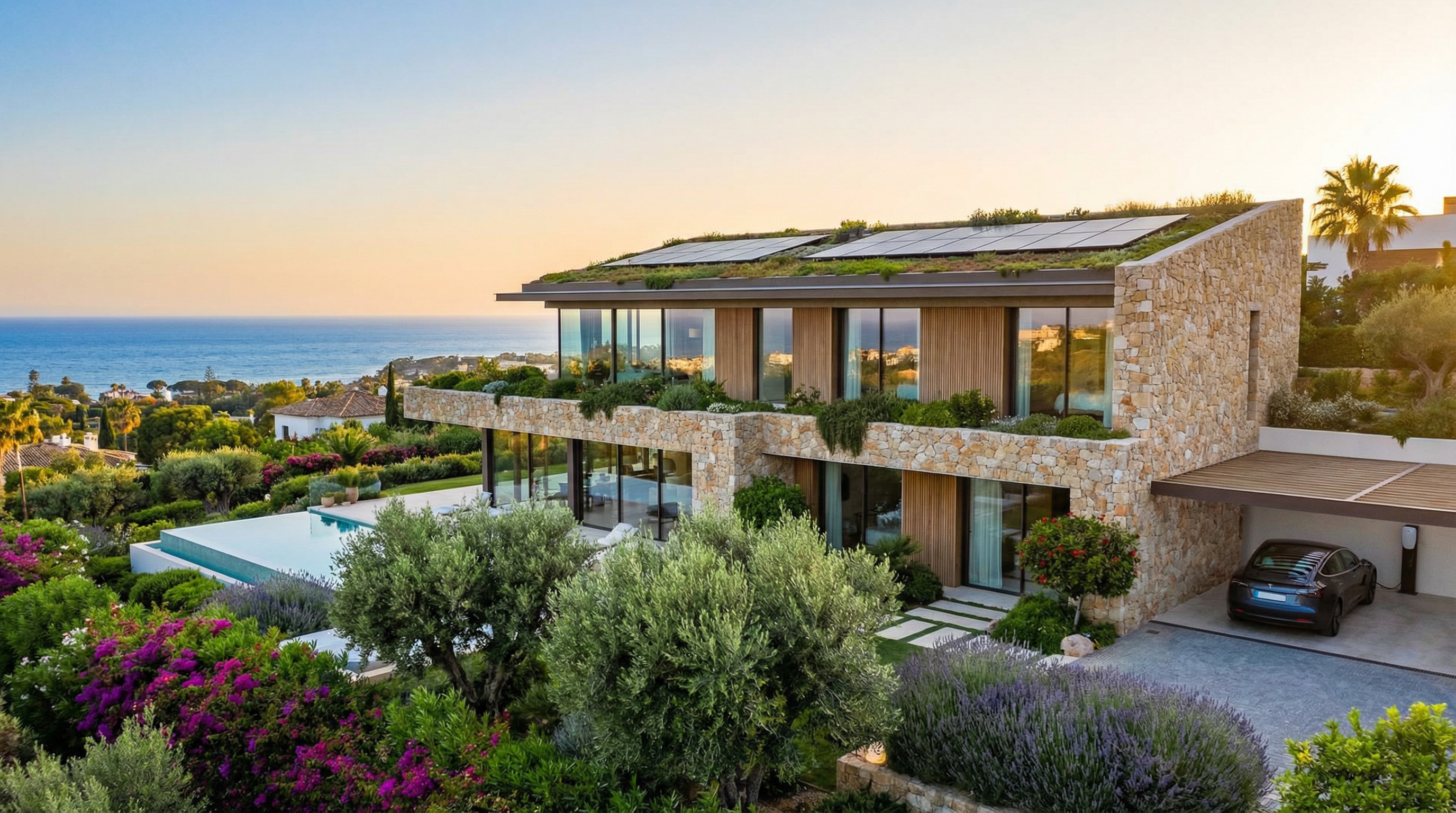
Sitting at a beachfront café in Puerto Banús, we’re often asked: does an Energy Performance Certificate (EPC) really matter when buying in Spain today? In 2026, the answer is a resounding yes. From our years guiding international buyers along the Costa del Sol, energy efficiency has moved from a “nice-to-have” to a core investment filter.
Why energy-efficient property in Spain matters in 2026
Spain is aligning with the EU’s decarbonisation roadmap, and that shows up in how homes are built, financed, and valued.EPC energy rating Spain explained simply: the letter grade (A–G) estimates consumption and CO₂ emissions. Buyers now use it to compare long-term costs and comfort, especially in sunny, cooling-heavy regions like Marbella and Estepona.
In our experience, energy-driven buyer demand is strongest among lifestyle owners who spend spring to autumn here. Efficient homes stay cool with less AC, reduce noise, and combat humidity. Investors see lower running costs and stronger tenant appeal, which supports liquidity at resale. Regulations are catching up, and banks increasingly favour green assets .
Key takeaways at a glance
- Expect stronger resale and liquidity for A–B rated homes as standards tighten .
- Lower bills and improved comfort year-round in Costa del Sol’s warm climate .
- Compliance matters:when marketing or selling property in Spain .
Background: What does sustainable building mean in Spain?
In Spain, sustainable new build means meeting thewith higher insulation, airtightness, solar readiness, and efficient HVAC (often aerothermal heat pumps). The current energy section of the code, CTE DB-HE, drives reduced demand and more on-site renewables .
Practically, this looks like high-performance glazing, shading, thermal bridges addressed in structure, mechanical ventilation with heat recovery in higher-spec homes, and pre-installation for solar PV. On the Costa del Sol, orientation, cross-ventilation, and shading (porches, louvres) are crucial for summer comfort without over-reliance on AC.
How EPCs work in Spain
- EPC grades run A (best) to G (worst) and must be shown in listings, contracts, and ads .
- Certificates are issued by qualified technicians and registered with the regional authority (e.g., Andalucía) .
- Typical turnaround is a few days; fees vary by size and location .
The benefits: comfort, cost efficiency, and future-proof value
We’ve helped hundreds of families compare similar homes where the EPC rating made the difference. In the Costa del Sol, efficient designs reduce solar gain and maintain stable humidity—vital for materials, artwork, and wine collections. You’ll feel it the moment you close the terrace doors on an August afternoon.
Long-term property cost efficiency is equally important. Efficient AC (inverter or aerothermal), LED lighting, induction cooking, and solar PV can meaningfully lower monthly bills. In communities with central hot water or pools, efficiency upgrades also stabilise service charges—good news for second-home owners .
Financial upside you can bank on
- Green mortgages: several Spanish lenders offer rate discounts or better LTV for EPC A–B homes .
- Insurance and maintenance: efficient systems often mean fewer breakdowns and may attract incentives .
- Resale liquidity: EU evidence links higher EPCs to price premiums and faster sales .
How to evaluate EPC, systems, and specs when viewing homes
We encourage buyers to treat energy performance like a second due diligence. You’ll understand comfort, running costs, and compliance risks before you sign. Here’s how we guide clients step-by-step when assessing energy performance property Spain-wide, with a focus on Marbella, Mijas, and Estepona.
Step-by-step energy check for buyers
- 1) Review the EPC: confirm rating, estimated kWh/m²/year, and CO₂ figures. Ask about the model (as-built vs. design) .
- 2) Inspect the envelope: glazing spec (e.g., low-E, solar factor), shading, insulation thickness, airtightness tests on new builds .
- 3) Check HVAC and hot water: aerothermal systems, SEER/SCOP ratings, zoning by room, and thermostat logic .
- 4) Ask for renewable readiness: installed PV or pre-wiring, battery readiness, EV charger points in the garage .
- 5) Water efficiency: dual-flush WCs, flow limiters, greywater or rainwater systems—a growing priority during drought cycles .
Insider checks we run for clients
- Summer test: visit at midday; note how quickly rooms cool, noise from units, and any heat build-up behind curtains.
- Community plant rooms: ask for efficiency measures and maintenance logs. Good communities invest in pumps, boilers, and solar thermal.
- Thermal imaging and blower door: on higher budgets, we arrange tests to verify performance before completion .
Standards decoded: BREEAM, LEED, and Passivhaus—what’s the difference?
Clients often ask: What is the difference between BREEAM, LEED, and Passivhaus? Each addresses sustainability differently. Understanding them helps you compare sustainable new build Spain developments with confidence and avoid superficial “green” claims.
BREEAM and LEED are broad sustainability rating systems. They score energy, water, materials, site, and management. Passivhaus is a performance standard focused on extremely low energy demand via envelope performance and airtightness.
How to use these labels when buying
- BREEAM/LEED: signal holistic sustainability; ask for the certified level and the building’s EPC to confirm energy outcomes .
- Passivhaus: strong on comfort and very low energy demand; excellent for Costa del Sol if shading and summer strategies are well-designed .
- Always pair the label with hard data: EPC grade, kWh/m²/year, and real utility bills where possible.
Important considerations, risks, and regulatory compliance
Regulatory compliance real estate Spain is tightening. An EPC must be available when advertising for sale or rent. Sellers face fines for non-compliance, and notaries typically request the certificate at completion . As your advisors, we verify the EPC early and align it with the building license and as-built specs.
Looking ahead, the EU’s recast EPBD will push minimum performance levels and building renovation passports, making poor ratings a future liability. Buying a low-rated home is still viable if you budget for upgrades, but ignoring performance is risky for finance, comfort, and resale .
Top risks we flag and how to manage them
- “Design EPC” vs. “as-built”: insist on updated, registered EPC after completion and snagging .
- Community rules: confirm permission for PV, batteries, or EV chargers; Spanish law supports EV points, but check statutes .
- Drought policies: landscaping and pool top-ups may face restrictions; favour efficient irrigation and water storage .
Market insights: Costa del Sol trends we see on the ground
In Q1–Q2 2026, most new developments in Marbella, Benahavís, and Estepona target EPC A–B with aerothermal systems, solar pre-installation, and EV-ready garages. Buyers explicitly ask for energy performance data during first visits—an unthinkable trend a few years ago .
Research across the EU links EPC performance with price premiums and quicker sales, a pattern we increasingly observe locally, especially in the €600k–€2m range. Efficient townhouses and apartments sell faster in communities with modern plant rooms, solar thermal, or PV on common areas .
Local realities that impact performance
- Orientation: south-west can be stunning at sunset but demands better shading; east-facing bedrooms cool naturally.
- Prevailing winds: Levante and Poniente affect cross-ventilation; smart window placement reduces AC use.
- Noise and comfort: quality glazing improves both efficiency and tranquillity near coastal roads.
Expert tips to future-proof your Costa del Sol purchase
You don’t need a PhD in building science to buy well. A few focused checks, plus the right team, safeguard comfort, compliance, and value. We’ve distilled our on-the-ground approach into practical actions that work for second-home owners and long-term residents alike.
Start by clarifying how you’ll use the home—seasonal or year-round—and your appetite for upgrades. Many “good bones” resales can leap two EPC grades with envelope and HVAC improvements, while new-build buyers can lock in performance from day one.
What we recommend in practice
- Target EPC A–B for new build; for resales, ensure a credible path to C or better with planned upgrades.
- Favour homes with aerothermal, PV readiness, EV points, and shading strategies that suit your lifestyle.
- Request an energy-focused snagging inspection before completion .
- Explore green mortgages and lender incentives for efficient homes .
- Budget an annual efficiency tune-up: filters, settings, and control optimisation with your property manager .
Putting it all together: a smarter, greener purchase in 2026
Energy performance now sits alongside location and layout for Costa del Sol buyers. Homes that blend smart design, efficient systems, and credible certification feel better to live in, cost less to run, and are easier to finance and resell. That’s what future-proof property investment looks like in Spain today.
If you’d like a calm, data-driven walkthrough of EPCs, systems, and running costs on a shortlist of homes, we’re happy to help. We’ll pair your lifestyle goals with the right specs, coordinate technical checks, and guide legal compliance from reservation to completion .
Buyer decision matrix
| Factor | Why it matters | What buyers should verify |
|---|---|---|
| Documents | Wrong sequencing can delay the purchase. | NIE, lawyer, bank account, tax budget and payment evidence. |
| Costs | The asking price is not the full budget. | Taxes, notary, registry, lawyer, bank, insurance and community fees. |
| New build | Off-plan payments need protection. | Licence stage, bank guarantees, payment plan and handover terms. |
Local buyer context
A safe buying decision connects documents, banking, tax, legal review and local practice before reservation.
A buyer comparing London, Belfast, Dublin, Manchester or Amsterdam routes usually weighs flight rhythm, family visits, remote work and quieter-month practicality.
For new builds, connect the topic with licences, payment plan, materials, shared facilities, handover and aftercare.
New-build focus: For new builds, connect the topic with licences, payment plan, materials, shared facilities, handover and aftercare.
