
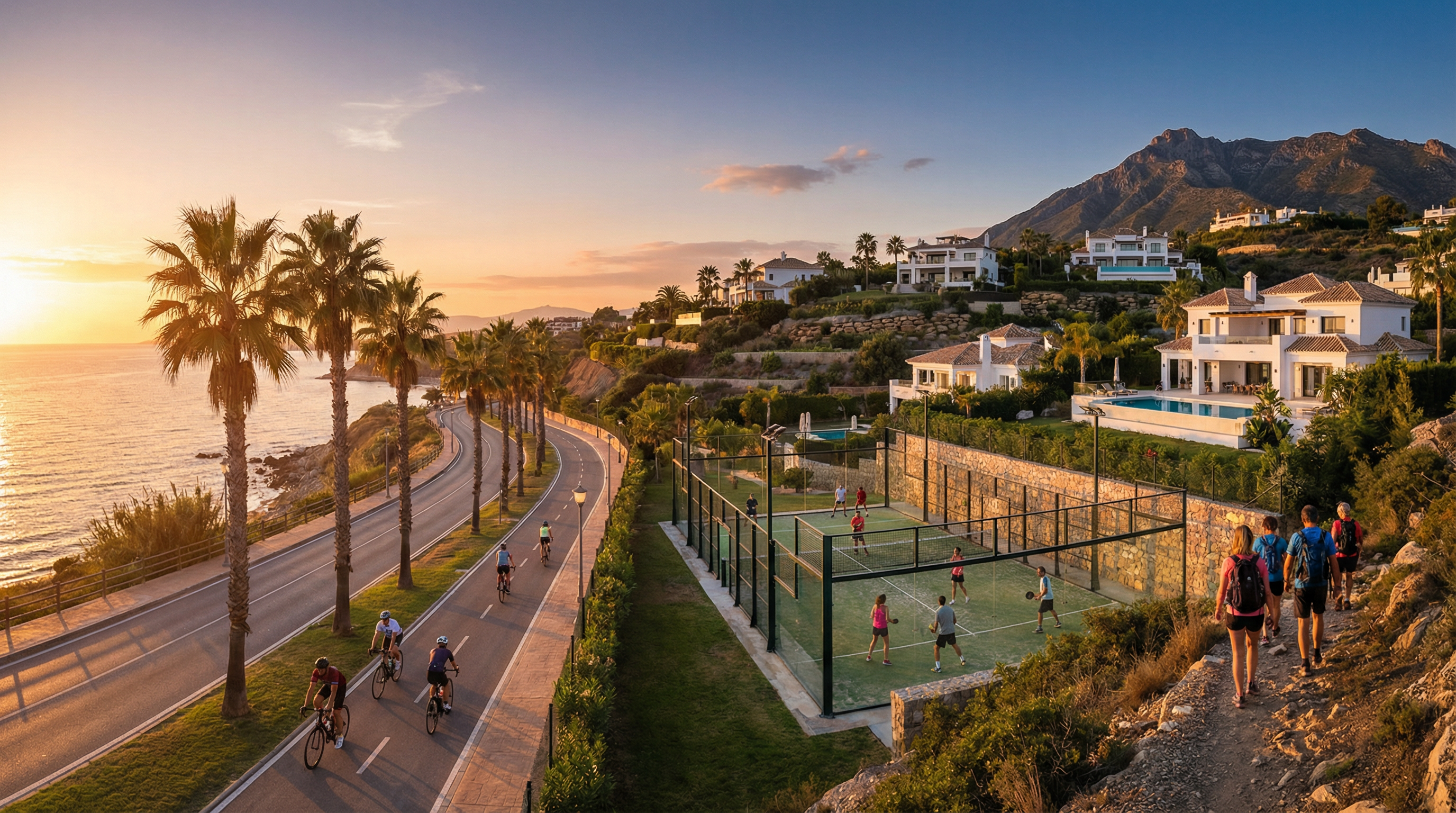
Sitting at a beachfront café in Puerto Banús, we often tell clients: this is where your calendar stops obeying the weather. On Tuesday mornings in January, we tee off in a polo; by afternoon, we hike a ridge above Benahavís. The Costa del Sol climate quietly removes barriers—so you can live actively, every week of the year.
Why the Costa del Sol climate is built for year-round outdoor sport
Across Málaga province, annual sunshine reaches approximately 2,900–3,200 hours—far above most of Europe—while average annual temperatures hover around 18–19°C.Rain typically clusters between November and March, leaving long, dry stretches spring through autumn—prime for golf, hiking, padel and cycling .
Winter highs commonly hit 16–20°C along the coast, while summer heat is moderated by sea breezes (Poniente) and the Mediterranean’s thermal buffer. UV is strong in summer, yet manageable with timing and shade—many clubs and trails adjust schedules accordingly .
Insider climate snapshot (what this means for your week)
From our day-to-day on the ground:
- Golf: Morning tee times year-round; shoulder seasons (Mar–Jun, Sep–Nov) are peak playability.
- Hiking: Coastal routes all year; mountain routes best Oct–May with clear skies after rain.
- Padel: Floodlit evening play in summer; mid-mornings ideal in winter.
- Cycling: Coastal rides all year; inland climbs best in spring/autumn; start early in peak summer.
You’ll notice microclimate shifts between Marbella’s Golden Mile, elevated Benahavís, and the open coast in Estepona. We guide clients to areas that match their sport routines .
The key benefits: health, performance, and lifestyle value
As your weekly routines compound, the climate’s consistency becomes your greatest performance edge. No gym-to-street compromise. You can schedule golf practice, interval rides, or a quick padel match without worrying about cancellations.
Health-wise, vitamin D exposure and outdoor movement support bone, heart, and mood health—especially important from age 45+. The sea air and year-round walking culture make 10,000 steps feel effortless along boardwalks from Marbella to San Pedro.
Three benefits we see every season
Based on hundreds of clients transitioning to active coastal living:
- Consistency: 300+ sunny days and light winds mean fewer weather cancellations and more steady progress .
- Recovery: Sea temperatures hover ~16°C in winter and ~23–24°C in late summer—cold-ish dips help recovery; warmer months encourage longer swims .
- Community: From padel ladders to Sunday cycling groups, clubs run 12 months a year—easy plug-in for newcomers .
We’ve seen clients reduce winter downtime by more than half after relocating. For second-home owners, it means your investment delivers well beyond summer—extending meaningful outdoor time into November, December, and February.
Where to play: best areas and facilities for golf, hiking, padel, and cycling
Because the coast is long and varied, matching sport priorities to micro-locations is key. We consider elevation, wind exposure, morning sun, and proximity to facilities before shortlisting homes.
For golfers, “frontline” or “walk-to-clubhouse” positions around Nueva Andalucía, Guadalmina, and El Paraíso are perennial favorites. Estepona’s new courses and upgrades offer value, while Mijas and Benalmádena attract year-round players with superb access and pricing .
Sport-by-sport highlights (our curated picks)
From our property and lifestyle view:
- Golf: Marbella’s Golf Valley (Las Brisas, Los Naranjos, Aloha) for elite playability; Finca Cortesín and Atalaya for variety; La Quinta for quick nine holes before sunset .
- Hiking: Benahavís and Istán ridge trails; La Concha for iconic views; coastal boardwalks (Senda Litoral) for daily steps.
- Padel: Puente Romano’s club in Marbella for premium facilities; Estepona’s expanding padel scene for availability; Mijas for year-round social ladders.
- Cycling: Coastal N-340 shoulders for easy spins; Casares and Ojén climbs for training; Ronda and Gaucín for endurance days with lower traffic .
If you’re balancing sport with lifestyle, we also look at walkability to cafés, clinics, and fitness—especially for long stays or future relocation .
How to plan your sport calendar through the seasons
With a predictable climate, your playbook becomes simple: match intensity to the calendar and adjust timing. We help clients design seasonal routines that maximize performance and enjoyment without overtraining.
Think of spring and autumn as performance seasons, winter as base-building and technique, and high summer as early-morning or sunset sessions with hydration support.
Four-step seasonal plan (what we recommend)
Use this framework; we tune it further during home searches and club introductions:
- 1) Winter (Dec–Feb): Mid-morning golf and padel; technique blocks; coastal hikes; 60–120 min endurance rides. Daytime highs 16–20°C; occasional rain windows after which skies clear beautifully .
- 2) Spring (Mar–May): Peak golf performance; longer hikes; sustained climbs to Ojén/Coin; padel leagues ramp up. Low rainfall and comfortable temps make this a favorite for visiting friends.
- 3) Summer (Jun–Aug): Start at sunrise or play under lights; seek sea-breeze-exposed courses; hydrate and use shade. UV index is high—apply broad-spectrum protection and schedule earlier sessions .
- 4) Autumn (Sep–Nov): Another performance window; ground is responsive, courses immaculate after light rains; stunning hiking clarity on cooler days.
For home logistics, line up memberships, health cover, and equipment storage early. We routinely coordinate club introductions and pro fittings alongside property viewings .
Important considerations: microclimates, wind, UV, and seasonality
The coast’s microclimates matter. Marbella’s Sierra Blanca creates a protective bowl; Benahavís is cooler at night; East Marbella beaches feel breezier; Estepona’s open coastline enjoys slightly stronger Poniente winds. We factor these nuances into property shortlists .
Occasionally, Andalucía faces drought cycles and temporary water-saving measures that can influence course maintenance and private landscaping. Well-managed clubs use reclaimed water and modern irrigation to stay playable; communities adapt planting accordingly .
Smart precautions we teach new residents
Keep your calendar smooth with these habits:
- Time your sessions: Earlier in peak summer; mid-morning in winter after the slight chill lifts.
- UV management: Wear UPF fabrics, caps, and use shade structures at padel courts; reapply sunscreen in high UV months .
- Wind awareness: On Levante days, choose sheltered courses or inland trails; Poniente days are golden for cycling along the coast .
- Hydration and recovery: Electrolytes in summer and light layers in winter keep performance steady.
With these basics, you can maintain a reliable training and play schedule in all twelve months.
Market insights: where active-lifestyle buyers are investing now
From our transactions in Q4 2025–Q1 2026, demand remains strongest for frontline or walk-to-course homes in Marbella’s Golf Valley and refined new-builds west toward Estepona. Buyers 45–70 prioritize club access, south or southwest terraces, storage for bikes, and low-maintenance landscaping.
Pricing (Q4 2025–Q1 2026, asking ranges, our brokerage data): Estepona frontline-golf apartments €350k–€700k; Nueva Andalucía golf apartments €650k–€1.3m; townhouses with buggy access €700k–€1.6m; Marbella golf villas €2.5m–€7m; Benahavís view villas €2m–€5m. Expect 8–12 weeks to close on resales when paperwork is ready.
What to budget beyond the purchase price
Plan realistically and your lifestyle starts smoothly:
- Closing costs: Typically 10–13% including taxes, notary, registry, and legal counsel .
- Running costs: Community fees often €2–€6/sqm/month in amenities-rich communities; IBI and waste taxes vary by municipality .
- Financing: Non-resident mortgages up to 60–70% LTV, terms 20–30 years; pre-approval helps when bidding .
- Residency: If planning longer stays, explore non-lucrative, digital nomad, or investor routes .
We also coordinate with clubs for membership options and trial rounds—useful before you commit to a specific community .
Expert tips from decades on the ground
After 500+ families guided through the process, patterns are clear: the right micro-location and floor plan make your active lifestyle effortless. A few small choices can upgrade your daily routine and long-term enjoyment.
Think orientation, airflow, and on-site facilities before décor. A south-facing terrace that catches winter sun may add 200 extra breakfast hours outdoors each year compared with a shaded alternative.
Seven practical ways to lock in year-round enjoyment
Use this as a checklist on viewings:
- 1) Orientation: Favor south/southwest to capture winter sun and sunset light.
- 2) Ventilation: Cross-breeze floor plans or ceiling fans support summer comfort without overreliance on A/C.
- 3) Storage: Dedicated space for clubs and bikes; consider a utility room near the entrance.
- 4) Proximity: Aim for under 10 minutes to your primary club or trailhead; ideally walk-to-clubhouse for daily practice.
- 5) Community facilities: Floodlit padel, heated pools, and gyms extend usage in shoulder months.
- 6) Shading: Pergolas and retractable awnings make summer terraces usable at midday.
- 7) Legal checks: Confirm licenses, community rules (e-bikes, sports gear storage), and short-term rental policies if relevant .
We can also introduce you to local pros and clubs to embed you socially from week one. The community piece is often the missing link for newcomers.
Conclusion: plan the lifestyle first, then choose the home
In our experience, the Costa del Sol climate is less a perk and more your quiet ally. It creates reliability—so your routines stick, friendships grow at the club, and every season feels open-ended. Start by mapping your sports calendar; we’ll align microclimates, clubs, and homes to fit.
When you’re ready, we’ll curate a shortlist and schedule a “liveability” day: a morning round, an afternoon trail, and an evening padel session. It’s the fastest way to feel what year-round outdoor life truly means on the Costa del Sol .
Buyer decision matrix
| Factor | Why it matters | What buyers should verify |
|---|---|---|
| Documents | Wrong sequencing can delay the purchase. | NIE, lawyer, bank account, tax budget and payment evidence. |
| Costs | The asking price is not the full budget. | Taxes, notary, registry, lawyer, bank, insurance and community fees. |
| New build | Off-plan payments need protection. | Licence stage, bank guarantees, payment plan and handover terms. |
Local buyer context
A safe buying decision connects documents, banking, tax, legal review and local practice before reservation.
A buyer comparing London, Belfast, Dublin, Manchester or Amsterdam routes usually weighs flight rhythm, family visits, remote work and quieter-month practicality.
For new builds, connect the topic with licences, payment plan, materials, shared facilities, handover and aftercare.
New-build focus: For new builds, connect the topic with licences, payment plan, materials, shared facilities, handover and aftercare.
