
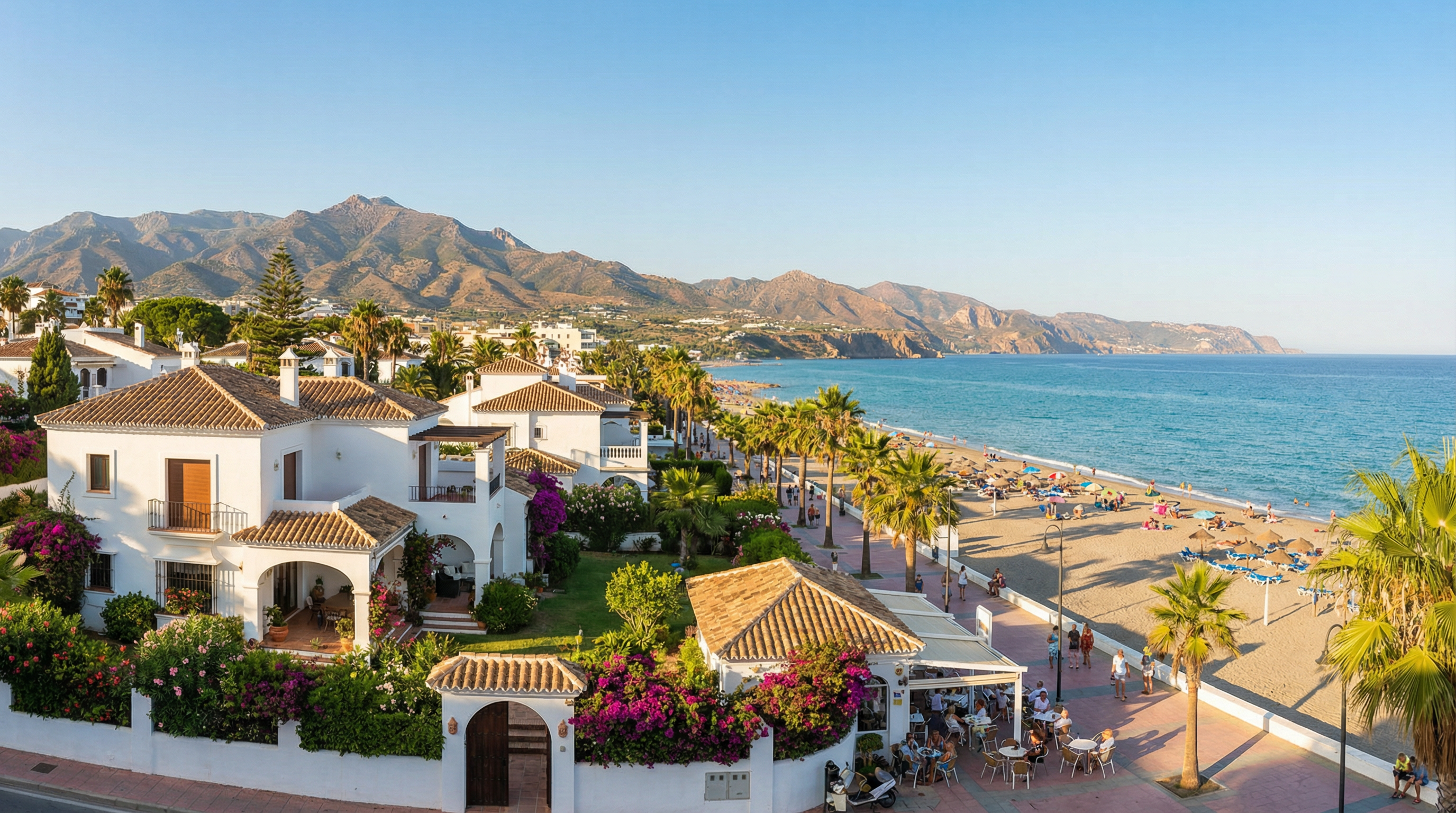
I’m Hans Beeckman, an Accredited Property Specialist who has called the Costa del Sol home for years. Over coffee in Puerto Banús, we’ve explained this to hundreds of buyers: you feel the sun more days here because nature conspires in your favor. Mountains, sea, and wind patterns craft a pocket of blue sky that sets our coast apart.
Costa del Sol vs. Other European Sunspots: A Climate Comparison
When you compare Europe’s beloved sun destinations, the Costa del Sol stands out for consistency. Málaga’s official records show roughly 2,900–3,000 sunshine hours annually, placing it among the very brightest mainland locations in Europe [AEMET climate normals 1991–2020]. Nice on the Côte d’Azur, Palma in Mallorca, and the Algarve are sunny too, but few combine as many blue-sky days with mild winters and low rainfall.
In our daily work from Marbella to Estepona and Benalmádena, we see the microclimate in action. Mornings open crisp and bright, breezes sweep moisture out to sea, and even winter afternoons invite a coffee on a south-facing terrace. That reliability is why the coast’s lifestyle—and property market—remain resilient year after year.
Why is the Costa del Sol the Sunniest Region in Europe? – The Microclimate Secret of Andalusia
Three forces shape this microclimate. First, the coastal mountain arc—Sierra Blanca, Sierra de Mijas, and Sierra Bermeja—creates a protective wall. This barrier deflects cooler, wetter Atlantic fronts and helps produce a local rain shadow [Instituto Geográfico Nacional orography data]. Second, the Alboran Sea stabilizes temperatures, softening both summer highs and winter lows [Puertos del Estado sea temperature climatology]. Third, a common Foehn-like downslope effect dries the air as winds spill seaward, suppressing cloud formation [AEMET synoptic patterns Andalusia].
Put simply: mountains block, the sea balances, and winds polish the sky. The result is a coastal strip with fewer rainy days (often 40–60 per year, depending on location) and more usable outdoor hours than most European coasts [AEMET precipitation normals 1991–2020]. It’s a climate engineered by geography.
Sunshine hours by key municipalities
Official and regional datasets show the following typical annual sunshine ranges (1991–2020 normals), with local variance due to elevation and exposure [AEMET Andalusia climate atlas]:
- Marbella area (Golden Mile, Nueva Andalucía): ~2,900–3,050 hours
- Estepona and New Golden Mile: ~2,850–3,000 hours
- Benalmádena and Torrequebrada: ~2,850–3,000 hours
- Fuengirola and Los Boliches: ~2,850–3,000 hours
- Mijas Costa and La Cala: ~2,850–3,000 hours
- Málaga Airport reference: ~2,900–3,000 hours [AEMET climate normals 1991–2020]
These ranges align with what we feel on the ground. On winter days, a south-facing terrace in Marbella can feel like late spring while inland villages sit under lingering cloud. That’s the microclimate working for coastal homeowners.
The Microclimate Engine: Mountains, Sea, and Wind—Explained Simply
Over 35+ years of combined experience with Del Sol Prime Homes, we’ve watched weather systems bounce off our ridge lines. Locals know it: when you see cloud sitting on Sierra Blanca’s crest, the sands of Puerto Banús may still be bathed in bright light.
Here’s how each part contributes:
1) Coastal mountain shield (Sierra Blanca, Sierra de Mijas, Sierra Bermeja)
The arcs behind Marbella, Mijas, and Estepona force moist air to rise, cool, and lose energy, often before reaching the shore. That creates a coastal rain shadow and boosts clear-sky frequency [Instituto Geográfico Nacional orography data]. Many Riviera-style towns in Europe lack this near-coast mountain barrier.
- Benefit to you: fewer gray days, better winter livability, and drier outdoor spaces.
- Buyer tip: homes tucked against these slopes often enjoy less wind and warmer winter terraces.
2) The Alboran Sea’s thermal governor
The western Mediterranean’s Alboran Sea keeps summers from overheating and winters from biting. Sea-surface temperatures here typically track 16–24°C through the year, limiting extremes that can trigger storms or fog [Puertos del Estado sea temperature climatology].
- Benefit to you: shoulder-season comfort for alfresco dining and morning swims.
- Buyer tip: proximity to the water brings steadier temperatures; a few hundred meters inland may feel warmer by day and cooler by night.
3) Foehn-like downslope winds and local breezes
When winds cross the ranges and descend to the coast, they compress and warm, thinning out low cloud. Typical regimes—the Poniente (westerly) and Levante (easterly)—regularly sweep humidity away, especially in summer [AEMET synoptic patterns Andalusia].
- Benefit to you: more blue-sky continuity during peak holiday weeks.
- Buyer tip: elevated plots catch cool evening breezes, lowering A/C use in July–August.
How Costa del Sol Compares with Other European Sunspots
We’re often asked to benchmark the Costa del Sol against the Algarve, Côte d’Azur, Balearics, Greek islands, and even the Canaries. Here’s the short version, using long-term normals and official sources.
Sunshine and rainfall, at a glance
- Málaga (Costa del Sol): ~2,900–3,000 h/year; ~450–550 mm rain/year [AEMET climate normals 1991–2020]
- Faro (Algarve): ~2,900–3,000 h/year; ~450–500 mm rain/year [IPMA Portugal climate normals 1991–2020]
- Nice (Côte d’Azur): ~2,700–2,800 h/year; ~700–800 mm rain/year [Météo-France climate normals 1991–2020]
- Palma (Mallorca): ~2,750–2,850 h/year; ~400–450 mm rain/year [AEMET Balearic Islands normals 1991–2020]
- Rhodes (Aegean): ~2,900–3,100 h/year; ~500–600 mm rain/year [Hellenic National Meteorological Service climate normals]
- Las Palmas (Canary Islands): ~2,800–2,900 h/year; mildest annual range [AEMET Canary Islands normals 1991–2020]
Takeaway: the Costa del Sol sits at the top tier for sunshine on mainland Europe, with exceptionally stable winter conditions—key for year-round living and rentals. Some islands rival our sun hours, but few match our blend of access, infrastructure, and winter warmth.
Why This Climate Advantage Matters for Property Buyers
Sunshine isn’t just a lifestyle perk—it affects comfort, running costs, and occupancy. We’ve watched families choose south-facing homes in Marbella or Mijas and then reduce winter heating while extending outdoor living into November and March.
Here’s how the microclimate translates into value:
1) More usable days, higher enjoyment
Expect 300+ sunny days most years along the coast, meaning terrace breakfasts and pool days stretch across seasons [AEMET Andalusia climate atlas]. Homes with winter sun exposure become genuine four-season residences.
- Action: Prioritize orientation and wind shelter in viewings [Marbella area guide].
2) Energy bills and solar production
With strong insolation (roughly 1,800–2,000 kWh/m²/year on horizontal planes near Málaga), rooftop PV can offset much of a typical villa’s daytime usage [European Commission PVGIS]. Pair that with cross-ventilation to reduce A/C peaks.
- Action: Ask for the Energy Performance Certificate (EPC) and roof load capacity [Spanish energy performance regulations IDAE].
3) Rental seasons and yields
Sun reliability underpins a long rental window from April to October, with winter short-lets to golfers and remote workers. Benalmádena and Fuengirola, thanks to transport links and mild winters, see steady off-season demand.
- Action: Model occupancy using shoulder-season data, not just August peaks [investing in Costa del Sol rentals].
Microclimate Pockets Along the Coast: Where It Feels Different
Even within 20 kilometers, conditions shift. In our on-the-ground tours, we often drive clients from the beach to the foothills to “feel” these nuances before they decide.
Marbella’s Golden Mile and Nueva Andalucía
Leeward of Sierra Blanca, these zones often enjoy calmer winter days and warmer terraces. South and southwest orientations shine in December–February. Sea breezes cool late afternoons in July–August.
- Buyer tip: Deep, covered terraces add summer shade; retractable glazing extends winter use.
Estepona and the New Golden Mile
Gently rolling topography with pockets that trap warmth on wind-sheltered afternoons. West of Estepona town, the coast curves, offering wide sea views and dramatic sunsets.
- Buyer tip: West-facing homes deliver golden-hour magic; combine with pergolas to soften midsummer sun.
Benalmádena and Torrequebrada
Hillside elevations collect breezes, ideal for those who dislike heat build-up. Expect a degree cooler at night than beachfront, with fast airport access for weekenders.
- Buyer tip: Prioritize cross-ventilation floorplans and ceiling fans to curb A/C use.
Mijas Costa and La Cala
Mix of beachfront humidity and set-back tranquility. Micro-valleys can feel warmer and calmer than open headlands on Levante days.
- Buyer tip: Visit at different times of day to judge wind exposure and evening damp.
How to verify a home’s microclimate (7 buyer steps)
We coach clients to turn climate into a viewing checklist. It’s simple, practical, and powerful.
- 1) Check the nearest AEMET station for sunshine, rainfall, and wind roses [AEMET data portal].
- 2) Map elevation and mountain alignment via Spain’s geoportal to gauge rain shadow [Instituto Geográfico Nacional geoportal].
- 3) Visit the property at morning, afternoon, and twilight to see sun paths and wind.
- 4) Stand on terraces in winter months; feel how quickly shade cools the space.
- 5) Ask for summer indoor temperature logs or smart-thermostat histories (many owners keep them).
- 6) Inspect for condensation marks, salt efflorescence, and terrace drainage after rain.
- 7) Review EPC and ask an engineer about PV yield on your roof pitch [European Commission PVGIS].
Seasonal Patterns: What You’ll Feel, Month by Month
Numbers are useful, but sensations sell a home. Here’s the feeling map we share during viewings, anchored by official norms in Málaga and coastal towns [AEMET monthly normals 1991–2020].
Winter (Dec–Feb)
Sunny most days, crisp mornings, mid-day terraces pleasant in the sun. Occasional Atlantic fronts bring brief rain bursts. Sea near 16–17°C moderates nights [Puertos del Estado sea temperature climatology].
- Tip: South/southwest orientations feel two “comfort” zones warmer than north-facing homes.
Spring (Mar–May)
Rapidly lengthening days, wildflowers inland, low humidity. By May, beach days are common; evenings can still be fresh in the hills.
- Tip: Pergolas or sail shades add flexibility as UV rises.
Summer (Jun–Aug)
Dry, bright, with reliable sea breezes. Peaks feel warm but less oppressive than some Mediterranean hotspots, thanks to the Alboran influence [AEMET synoptic patterns Andalusia].
- Tip: Elevated homes in Benalmádena and Mijas catch evening winds for natural cooling.
Autumn (Sep–Nov)
Glorious sea warmth lingers into October. Short, intense rain events can occur in late autumn—quick in, quick out—followed by clear skies [AEMET precipitation normals 1991–2020].
- Tip: Verify terrace drainage, guttering, and slope to protect outdoor tiles.
Risks and Realities: What the Sunshine Story Doesn’t Hide
We believe in full transparency. Even the sunniest coasts have weather caveats. The key is planning for them—before you buy.
Short, heavy rain and runoff
Late autumn can bring high-intensity showers. Choose plots with good drainage and avoid known flood basins by checking official maps [Junta de Andalucía flood hazard maps].
- Action: Ask your lawyer to include a flood-zone check in due diligence [buying process in Spain].
Saharan dust (calima)
Occasional dust intrusions raise haze and soil terraces. Frequency has trended upward across the western Mediterranean in some years [Copernicus Atmosphere Monitoring Service].
- Action: Install easy-clean exterior finishes; consider MERV-rated filters on HVAC.
Wildfire awareness inland
Foothill and rural plots must follow brush clearance rules, especially near protected areas [INFOCA Junta de Andalucía].
- Action: Confirm municipal fire-break requirements during conveyancing [relocating to Costa del Sol].
Expert Tips from the Field: Designing for the Costa del Sol Microclimate
After facilitating over €120M in transactions, we’ve learned which features make homes live bigger under Andalusian skies.
Orientation, shading, and airflow
Prefer south or southwest exposure for winter warmth. Add adjustable shading (louvers, pergolas) and ensure cross-ventilation through aligned openings.
- Tip: Deep roof overhangs target high summer sun; low winter sun still enters living spaces.
Materials and outdoor rooms
Choose light-colored facades and high SRI roof finishes. Combine covered and uncovered terraces to “tune” comfort across seasons.
- Tip: Non-slip porcelain with light tones reduces heat and glare on terraces.
Energy and resilience
Solar PV plus a heat pump (for heating and cooling) matches our climate profile well. Battery storage can shift sunny-day surplus to evenings [European Commission PVGIS].
- Tip: Ask for recent utility bills and EPC class; compare similar homes in Benalmádena and Mijas to see the effect of elevation [Mijas property market insights].
Conclusion: Turn Sunshine into Everyday Comfort—and Smart Investment
The Costa del Sol’s microclimate is more than a slogan. Mountains shield, the sea moderates, and winds clear the sky—delivering one of Europe’s most reliable blends of sunshine and mild seasons. That consistency amplifies lifestyle, underpins rental calendars, and lowers running costs.
If you’re weighing Marbella against the Algarve or the Côte d’Azur, we’ll help you test microclimate on-site—orientation, breezes, and terrace comfort—before you commit. Let’s map options across Marbella, Estepona, Fuengirola, Benalmádena, and Mijas, and align climate with your goals [Marbella area guide] [best neighborhoods in Estepona] [Benalmádena living guide] [Mijas property market insights] [beachfront apartments Costa del Sol] [buying process in Spain] [mortgage options for non-residents Spain] [property taxes in Andalusia].
Buyer decision matrix
| Factor | Why it matters | What buyers should verify |
|---|---|---|
| Documents | Wrong sequencing can delay the purchase. | NIE, lawyer, bank account, tax budget and payment evidence. |
| Costs | The asking price is not the full budget. | Taxes, notary, registry, lawyer, bank, insurance and community fees. |
| New build | Off-plan payments need protection. | Licence stage, bank guarantees, payment plan and handover terms. |
Local buyer context
A safe buying decision connects documents, banking, tax, legal review and local practice before reservation.
A buyer comparing London, Belfast, Dublin, Manchester or Amsterdam routes usually weighs flight rhythm, family visits, remote work and quieter-month practicality.
For new builds, connect the topic with licences, payment plan, materials, shared facilities, handover and aftercare.
New-build focus: For new builds, connect the topic with licences, payment plan, materials, shared facilities, handover and aftercare.
