
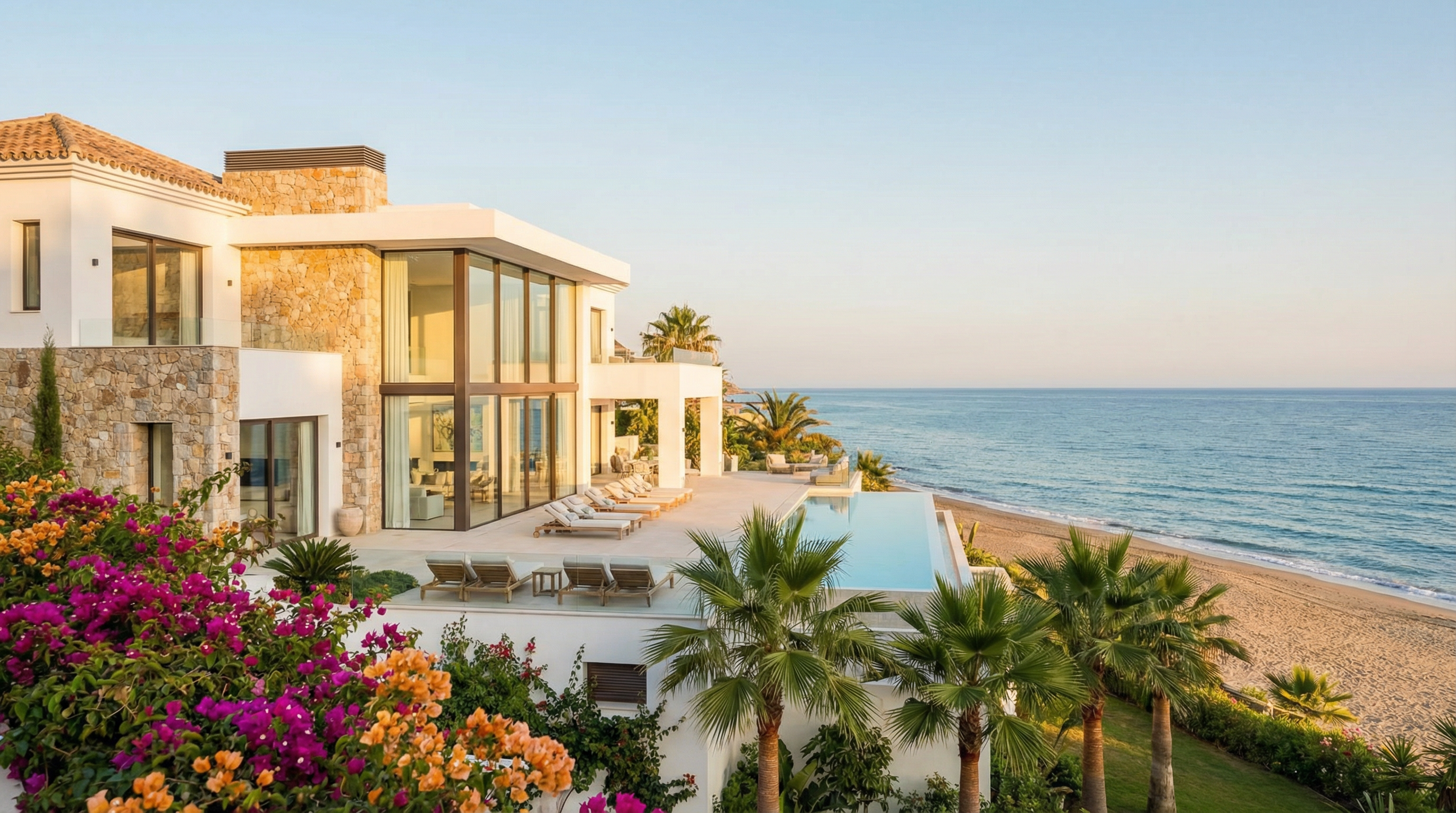
We’ve spent years guiding international buyers who arrive for the beaches and stay for the light. The question we hear most—Why is the Costa del Sol the Sunniest Region in Europe? – The Microclimate Secret of Andalusia—has a precise, scientific answer and clear implications for your property. In simple terms: mountains, sea, and wind patterns conspire in your favor.
Why does the Costa del Sol get so much sun compared to the rest of Europe?
Geography does the heavy lifting. The coastal ranges—Sierra Blanca (Marbella), Sierra Bermeja (Estepona), Sierra de Mijas (Fuengirola/Mijas), and Montes de Málaga—block cooler, wetter air from the north. This creates a rain-shadow and frequent föhn warming that keeps clouds at bay [AEMET climate atlas].
The Alborán Sea moderates temperatures, smoothing out winter chills and summer spikes. Above it all, the Azores High often extends east, reinforcing clear, stable conditions. The result is 2,800–3,000 sunshine hours per year and relatively low annual rainfall for a Mediterranean coast, often near 400–600 mm in key coastal towns [Copernicus Climate Data Store].
How local winds and terrain fine-tune the microclimate
Levante (easterly) and Poniente (westerly) winds shape daily comfort. Levante can bring humidity; Poniente often delivers crisp, clear air. Sea-breeze circulations each afternoon further regulate heat, making terraces comfortable even in July and August [WMO Mediterranean climate guidance].
- Marbella’s La Concha peak funnels breezes and shelters the Golden Mile.
- Estepona’s Sierra Bermeja reduces cloud formation and winter wind chill.
- Mijas/Fuengirola benefit from the Sierra de Mijas barrier and open bays for ventilation.
What this microclimate means for your lifestyle and investment
More sunshine translates into more usable days outdoors. You’ll dine al fresco in February, enjoy stable pool seasons from April to October, and rely less on heating. For many of our northern European clients, this adds real personal value, not just rental returns.
On the numbers side, sunny weather expands tourism seasons. That supports higher occupancy, stronger nightly rates, and recurring winter bookings for golf, wellness, and workcations. We’ve seen well-managed holiday lets in prime microclimate pockets outperform inland peers by widening their “shoulder months.”
Where to buy for year-round comfort (our field-tested picks)
Microclimate matters street by street. In Marbella, the sheltered Golden Mile and Nueva Andalucía valleys feel warmer in winter and less gusty. Estepona’s New Golden Mile enjoys gentle breezes and less cloud. Benalmádena Pueblo sits above humid layers yet stays mild.
- Marbella: Golden Mile, Sierra Blanca foothills, Nueva Andalucía.
- Estepona: New Golden Mile, Seghers, El Paraíso, Atalaya.
- Fuengirola/Mijas: El Higuerón/Reserva del Higuerón, La Cala de Mijas.
- Benalmádena: Pueblo and Torrequebrada for views plus air flow.
Step-by-step: Buying a microclimate-smart home on the Costa del Sol
At BOFU stage, clarity is everything. Here’s a practical path we use with clients, tuned for climate, comfort, and returns. It blends our transaction workflow with on-the-ground weather realities.
1) Define usage and returns. Decide your split between personal use and rentals. If winter sun is key, prioritise sheltered zones near golf and services. For short-let yield, look where seasonality is flatter and rules are clear [rental yield analysis Costa del Sol].
2) Get finance pre-approval. Non-resident mortgages typically finance 60–70% LTV, with rates set over Euribor. Banks will request income proofs and a valuation. Pre-approval in 1–3 weeks is typical for clean files [Bank of Spain mortgage statistics].
3) Line up your NIE and buyer’s counsel. You’ll need the NIE tax number to buy, open accounts, and sign. Your independent lawyer will verify planning status, debts, and licensing. NIEs often take 1–4 weeks via Spanish consulates or local police [Gobierno de España NIE process].
4) Plan a microclimate-aware viewing trip. Visit across two days to sample Levante and Poniente. Stand on terraces at midday and sunset. Listen for wind corridors and check damp-prone zones behind hills [viewing trip planning Costa del Sol].
5) Compare new-build and resale options. New-builds offer higher energy ratings and modern insulation; resales may give prime, sheltered locations at better value. We assess ventilation, orientation, and shading for thermal comfort year-round [new build vs resale in Costa del Sol].
6) Make a data-backed offer. We benchmark recent sales, not list prices, and account for terrace utility and exposure. In winter-sun pockets, an extra 10–15 m² of sheltered outdoor space can justify premium pricing when rental income is considered [due diligence checklist Spain property].
7) Legal checks and taxes. In Andalucía, resale purchases pay a 7% Transfer Tax (ITP). New-builds pay 10% VAT (IVA) plus 1.2% Stamp Duty (AJD). Budget also for notary, registry, and lawyer fees [Junta de Andalucía tax rates 2025].
8) Completion and setup. Resale timelines are 8–12 weeks; mortgages may extend slightly. We arrange utilities, tourist licence guidance where applicable, and property management setup tuned for year-round guest comfort [property management services Costa del Sol].
Viewing checklist: climate comfort in 10 minutes
We coach buyers to test terraces during breezy hours, open/close shutters to gauge shade, and walk north-side walls for moisture signs. Ask for past electricity bills to understand winter heating and summer cooling loads. Confirm cross-ventilation and ceiling fan points.
- Check orientation: south/southwest for winter sun, east for cooler summers.
- Inspect glazing, awnings, and pergolas for UV and heat control.
- Note elevation: a few meters up can reduce humidity and noise.
Costs, regulations, and climate-related risk checks
Good weather reduces some risks but not all. We routinely verify if a home lies near arroyos (dry riverbeds) or low-lying pockets where intense Mediterranean storms can pool water. Spain’s national flood maps help us evaluate residual risks beyond “average sunshine” headlines [MITECO flood risk maps].
Ownership costs remain predictable. Besides ITP/IVA and AJD, allow roughly 0.3–0.5% for notary, 0.15–0.3% for registry, and 0.5–1.5% for legal fees. Holiday-rental licensing varies by municipality and community bylaws, so we verify usage early [Junta de Andalucía tourism regulations].
Insurance, energy, and building performance
Sunny climates call for robust solar control. We favor double glazing, external shading, and efficient HVAC. Premiums for home insurance are often competitive in low-flood, low-hail settings; still, we ask for claims histories and engineering certificates where available [Spanish insurance supervisor guidance].
- Solar PV and heat pumps can cut bills and add rental appeal.
- Salt air suggests marine-grade fixtures and proactive maintenance.
- Pools benefit from covers or heat pumps for shoulder-season comfort.
Current market insights: Q1 2026 snapshot from our desk
We track the market daily through completions and appraisals. In Q1 2026, turnkey two-bedroom apartments within walking distance to beach or marina areas typically range: Marbella €600k–€900k, Estepona €350k–€700k, Fuengirola €280k–€550k, Benalmádena €300k–€600k, Mijas €250k–€500k.
New-build supply is strongest in Estepona West and the El Higuerón corridor, with energy-efficient specs and amenities that renters love. Well-managed short-lets in prime microclimate pockets often show 4–7% gross yields, with extended winter occupancy anchored by golf and remote work demand [best neighborhoods Marbella microclimates].
What we’re seeing on the ground
Buyers are prioritizing terraces with wind protection, winter-sun exposure, and on-site wellness facilities. Homes one notch above sea level—yet not exposed to open gusts—are winning bidding contests. The microclimate edge is now priced in, but still leaves room for value in near-prime blocks.
- Estepona’s New Golden Mile: best value-to-amenity mix near beach.
- Marbella’s foothills: quieter, warmer winter feel with views.
- Benalmádena Pueblo to Higuerón: panoramas plus easy airport access.
Hans’ expert tips for a sun-smart purchase
In our experience helping over 500 families, the best homes blend design and location. We once advised a Swedish family to trade a wind-exposed penthouse for a slightly lower-floor corner with deeper eaves. Their winter stays transformed—sunny breakfasts, lower heating bills, happier guests.
Think “climate stack”: orientation, elevation, shielding, and airflow. Tour at different times of day, and bring a light meter app to compare terrace sunlight. Finally, give extra weight to buildings with modern envelopes, as they preserve comfort during Levante spells [legal conveyancing in Spain].
Microclimate negotiation levers
Point out exposure issues during offers—lack of shading, single glazing, or wind corridors. Use quotes for awnings or glazing upgrades as price anchors. Conversely, pay up for a sheltered, south-facing terrace if you’ll rent in winter—it pays back fast in occupancy.
- Request historic utility bills to quantify comfort and costs.
- Ask for community rules on awnings and enclosures before bidding.
- Document any water ingress or damp for remedial holdbacks.
Conclusion: Turn Andalusia’s microclimate into your advantage
The Costa del Sol’s sunshine isn’t luck—it’s geography. Mountains shield, breezes balance, and the Alborán Sea softens seasons. When you buy with microclimate in mind, you gain comfort, stronger rental seasons, and lower operating friction.
If you’re ready, we’ll plan a climate-smart viewing, secure finance, and negotiate with precision. Start with your budget and usage goals, then explore our guides on costs, mortgages, and neighborhoods to move forward confidently [property buying costs in Andalusia] [mortgage options for non-residents Spain] [best neighborhoods Marbella microclimates] [NIE number Spain guide].
Buyer decision matrix
| Factor | Why it matters | What buyers should verify |
|---|---|---|
| Documents | Wrong sequencing can delay the purchase. | NIE, lawyer, bank account, tax budget and payment evidence. |
| Costs | The asking price is not the full budget. | Taxes, notary, registry, lawyer, bank, insurance and community fees. |
| New build | Off-plan payments need protection. | Licence stage, bank guarantees, payment plan and handover terms. |
Local buyer context
A safe buying decision connects documents, banking, tax, legal review and local practice before reservation.
A buyer comparing London, Belfast, Dublin, Manchester or Amsterdam routes usually weighs flight rhythm, family visits, remote work and quieter-month practicality.
For new builds, connect the topic with licences, payment plan, materials, shared facilities, handover and aftercare.
New-build focus: For new builds, connect the topic with licences, payment plan, materials, shared facilities, handover and aftercare.
