
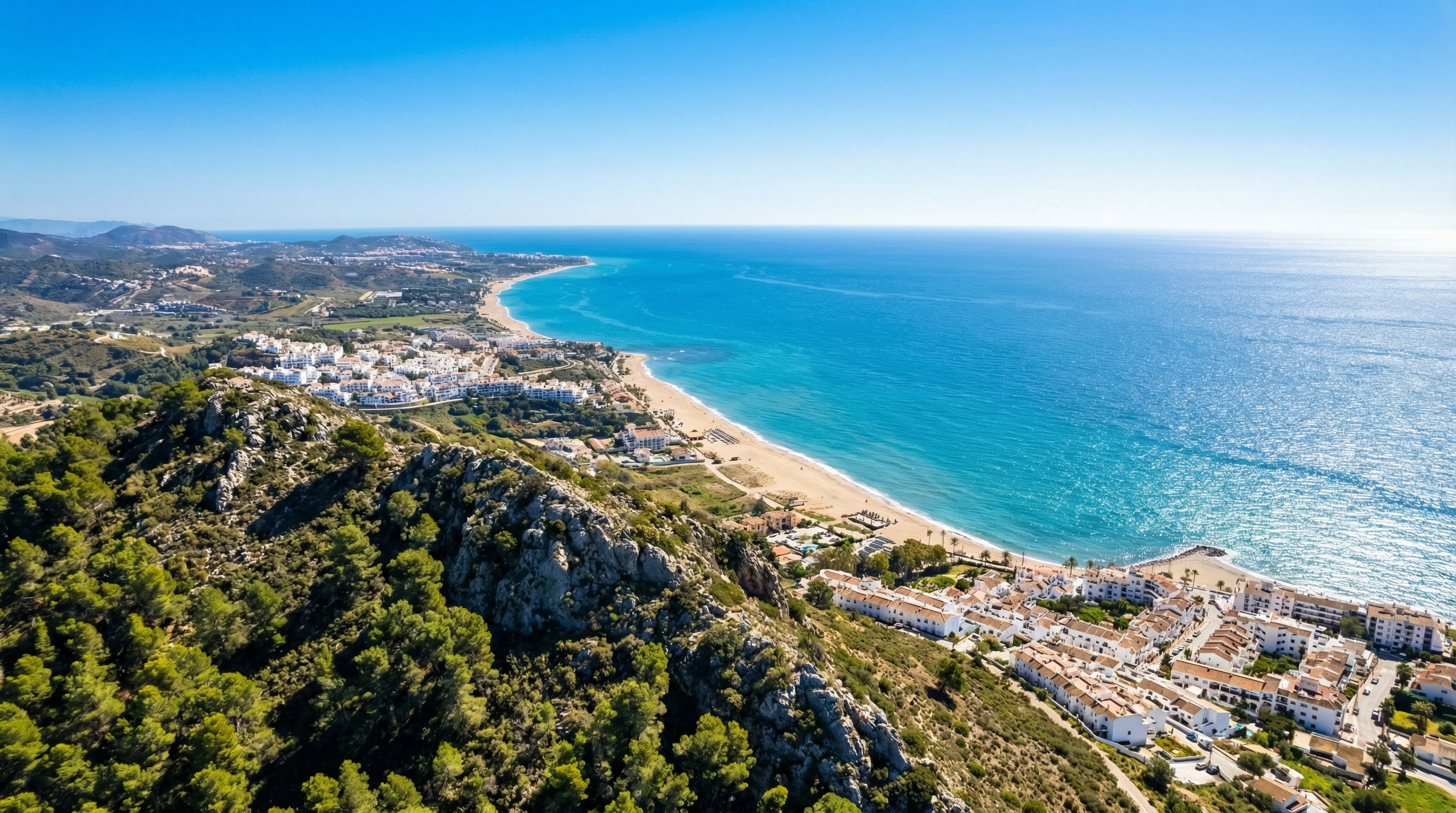
We’re writing this from a beachfront café in Puerto Banús, where mornings start with a gentle sea breeze and afternoons end in golden light. After many years helping international families buy here, we’ve seen why this coast wins hearts: sun, stability, and an outdoor lifestyle that works 12 months a year. But it isn’t luck — it’s geography. Understanding the Costa del Sol’s microclimate will help you choose the right area, design the right home, and protect your investment for the long term.
Why is the Costa del Sol the Sunniest Region in Europe? – The Microclimate Secret of Andalusia
The Costa del Sol sits between the Alboran Sea and steep coastal ranges — Sierra Blanca, Sierra de las Nieves, and Sierra Bermeja — which act like a natural weather wall. These mountains block moist Atlantic systems, creating a rain shadow and more stable skies over the coast [AEMET climate normals 1991–2020].
On many days, westerly (Poniente) or easterly (Levante) winds accelerate through the Strait of Gibraltar. They sweep clouds away and promote clear, dry air along Málaga’s shoreline. That’s why Málaga stations average around 2,900 sunshine hours annually, with some coastal pockets edging higher — among the best in mainland Europe [AEMET climate normals 1991–2020]. Broader European solar maps confirm Southern Spain as a top sunbelt, with local peaks near Málaga and Almería [Copernicus Climate Change Service solar radiation Europe].
How Does Geography Create So Much Sun? (Mountains, Sea, and Winds)
Think of the Baetic ranges as a protective horseshoe around the coast. When humid air climbs those slopes, it cools, drops rain inland, and dries out by the time it descends to Marbella, Estepona, Benalmádena, Mijas, and Fuengirola — the classic Föhn effect [University meteorology text or AEMET educational resource].
The Alboran Sea adds a second layer of stability. Cooler Atlantic inflows moderate summer highs, while relatively warm winter sea temperatures soften cold snaps. The result is fewer thermal contrasts and fewer storm triggers along the shoreline [Puertos del Estado sea temperature Alboran].
Insider explainer: The rain shadow and Föhn effect in 3 steps
We often show buyers this simple sequence on a map during viewings:
- 1) Lift: Atlantic air hits the Baetic mountains and rises, cooling and shedding moisture inland.
- 2) Dry down-slope: Air descends toward the coast, warms adiabatically, and dries out — fewer clouds form.
- 3) Stable coast: The sea breezes and Gibraltar winds keep skies clear and temperatures balanced.
Why Levante and Poniente matter for blue skies
These opposite winds channel through the Strait of Gibraltar, often scouring clouds from the Málaga littoral. The Poniente tends to bring drier, clearer air; Levante can be more humid but still promotes cloud breakup as it funnels along the coast [AEMET Levante and Poniente wind studies].
What Does the Microclimate Mean for Your Lifestyle and Property?
In practical terms, you get reliable winter sun for terraces and golf, and summers that feel warm but not oppressive by the water. Málaga’s coast often runs 2–5°C cooler than inland valleys in August thanks to sea moderation [AEMET coastal vs inland temperature normals].
For property, that stability means higher year-round utility. Heated pools, south-facing terraces, and glass systems earn their keep from October to April. Rental calendars stretch longer, especially in Marbella–Estepona and Benalmádena–Fuengirola micro-belts with consistent sun exposure [property management and rentals Costa del Sol].
Month-by-month feel (so you can plan usage and rentals)
From our experience scheduling client stays:
- Nov–Feb: Crisp mornings, 16–19°C afternoons, bright sun more often than not; ideal for hiking and golf [AEMET seasonal normals Málaga].
- Mar–May: Early beach days, blossoms in the hills, steady sunshine hours; strong shoulder-season rentals.
- Jun–Aug: Dry heat tempered by sea breezes; evenings outdoors without heavy humidity.
- Sep–Oct: Warm seas, calm winds, and spectacular sunsets; one of the best times for second-home use.
How to Use the Microclimate to Choose the Right Area
Not all 20 km are equal. A hill, a headland, or a ravine can shift wind, sun, and morning fog. We’ve guided hundreds of families to match micro-zones with lifestyle, whether you want quiet winter warmth, cool summer nights, or year-round rental demand.
Before you tour homes, map your climate preferences to sub-areas in Marbella, Estepona, Benalmádena, Fuengirola, and Mijas. Then test them in person, at different times of day.
Five steps we use with clients to “read” a micro-location
Follow this during your next viewing day:
- 1) Face the sun: Note terrace orientation (south, southwest, or southeast). South gets winter midday sun; southwest gives late-afternoon warmth.
- 2) Check wind channels: Stand at balcony corners. Sea breeze from the south and Poniente from the west cool summers; deep gullies can funnel gusts.
- 3) Observe shade: Nearby hills or taller blocks can steal winter rays after 3 pm. Use your phone’s compass and a sun-path app.
- 4) Compare temps: Drive 5–10 minutes inland. Feel the 2–4°C rise on peak summer days; decide how much cooling you want.
- 5) Return at dusk: Evening thermals vary by slope; test outdoor dining comfort and any katabatic (downslope) breezes.
As you shortlist, match area strengths to your goals: golf-front ease in Mijas [Golf properties in Mijas and La Cala], beach walks in New Golden Mile [New developments and off-plan projects Costa del Sol], or marina life in Benalmádena [Best sea-view villas in Benalmádena and Torremolinos].
Important Local Variations You Should Know
Marbella (Sierra Blanca shelter): The mountain backdrop blocks northerlies, creating calm winter terraces on the Golden Mile and Nueva Andalucía. East Marbella (Elviria–Cabopino) enjoys wider beaches and more breeze — great for summer balance [Marbella neighborhood guide].
Estepona (Sierra Bermeja influence): Western Estepona can see a touch more rainfall in certain months due to orography, but also benefits from fabulous sunsets and extended shoulder-season warmth [Junta de Andalucía climate maps].
Benalmádena–Torremuelle (elevated views, faster breeze): Hillside villas get extra air movement on hot days; choose smart glazing for winter evenings to keep the sunset rooms cozy.
Fuengirola–Los Boliches (broad bay): Gentle sea breezes and easy winter sun on south-facing promenades — a favorite among long-stay renters.
Mijas Pueblo and inland valleys: A few kilometers from the sea can add summer warmth and crisper winter nights. In return, you gain panoramic views and tranquil settings [Coastal vs inland living in Málaga province].
Orientation and design choices that pay off
We advise purchasers to blend climate and architecture:
- 1) Winter sun capture: Prioritize south or southwest terraces and low-winter-sun exposure for living rooms.
- 2) Summer shading: Pergolas and deciduous planting cut August glare without losing spring light.
- 3) Cross-ventilation: Dual-aspect rooms leverage daily sea breezes; ceiling fans reduce AC loads.
- 4) Thermal mass: Stone and insulated envelopes stabilize day–night swings in hillside homes.
Market and Climate Data: What the Numbers Say
Málaga Airport’s recent climate normals indicate about 2,900 sunshine hours annually and mild winter averages above 12–13°C, supporting year-round outdoor life [AEMET climate normals 1991–2020]. European datasets place Southern Spain among the continent’s top solar exposure corridors, aligning with Costa del Sol’s “300+ sunny days” reputation [Copernicus Climate Change Service solar radiation Europe].
Rainfall concentrates in brief autumn–winter episodes, with many dry months. Orography means pockets vary: western outcrops can receive more rain than central Marbella, while protected bays often see quicker clearing after fronts [AEMET precipitation normals Málaga province].
Resilience, drought notes, and water planning
Andalucía cycles through dry periods, and local authorities may set temporary water-saving measures in lower-rainfall years. Modern communities now pair efficient irrigation, greywater reuse, and drought-tolerant landscaping — practical if you plan a garden or pool [Junta de Andalucía drought measures and water restrictions].
We help buyers audit building specs (insulation, windows, water systems) so comfort stays high and bills stay predictable [Cost of owning a home in Costa del Sol].
Key Benefits for Buyers: How the Microclimate Protects Value
Extended lifestyle season: You’ll dine outdoors most of the year and swim earlier and later than in many Mediterranean hubs. That translates to higher personal use and stronger shoulder-season bookings [property management and rentals Costa del Sol].
Lower climate risk profile: The coastal mountains reduce exposure to winter cold snaps and summer extremes compared with inland Spain, a plus for long-term livability and maintenance [AEMET coastal vs inland temperature normals].
Energy efficiency potential: With good orientation and cross-ventilation, owners can cut cooling loads in summer and enjoy passive solar gains in winter, stabilizing running costs — something lenders also appreciate when assessing affordability [Mortgage options for non-residents Spain].
Design and amenity choices that enhance ROI
From our portfolio, these features rent and resell well:
- 1) All-season terraces: Retractable glazing and heaters for winter sun; shading for August afternoons.
- 2) Heated pools or plunge pools: Extend usage months, appealing to families and golfers.
- 3) EV-ready parking and solar prep: Future-proofs the home and attracts eco-minded tenants.
- 4) Walk-to-beach locations: Consistent breezes and easy access keep occupancy high.
How to Evaluate a Property’s Climate Fit (Step-by-Step)
During due diligence, we test both data and feel. A quick field checklist saves surprises later and ensures your home suits how you actually live — morning coffee on the terrace, a 3 pm swim, or sundowners with a view.
Combine AEMET norms, a site visit at two times of day, and a simple shading analysis. Then make small design tweaks for a “just right” home.
Your 6-step microclimate checklist on viewing day
Bring this with you:
- 1) Sun-path check: Use a phone app to see winter and summer arcs; verify winter midday sun hits key terraces.
- 2) Breeze test: Note wind corners and cross-ventilation; open opposite windows to feel airflow.
- 3) Noise vs. wind trade-off: Breezy spots can be quieter than valley floors; assess both.
- 4) Material touch: South walls warm gently in winter; poor glazing feels cold by dusk — plan upgrades.
- 5) Pool positioning: Aim for at least six hours of sun in winter shoulder months for heated pools.
- 6) Night cool-down: If inland, check evening temperature drops; consider ceiling fans and shading.
We document all this in our buyer report, alongside legal and cost checks [Buying property process in Spain step-by-step] and any residency pathway you may explore [Golden Visa property investment Spain].
Expert Tips from Years on the Ground
After facilitating more than €120M in transactions, we’ve learned a few simple rules. In Marbella–Estepona, late-afternoon sun sells; in Benalmádena, breeze and views drive value; in Mijas, cross-ventilation matters as much as AC. The right micro-bet compounds your comfort and returns.
We’ve also seen buyers win by prepping for both February breakfasts and August siestas — a reversible terrace system does more than any single gadget.
Two quick playbooks: owner-occupier and investor
Pick your lane and optimize:
- 1) Owner-occupier: Prioritize winter sun exposure, wind-sheltered dining, and acoustic calm. Add pergolas and outdoor heaters for year-round use.
- 2) Investor: Target walkable beach zones with steady breezes, plan for shade in peak summer, and add pool heating for off-season bookings [property management and rentals Costa del Sol].
Conclusion: Sun as a Strategy — Not Just a Lifestyle
The Costa del Sol’s microclimate is no myth; it’s a measurable edge created by mountains, sea, and wind. That edge turns into daily comfort, longer rental seasons, and resilient property value. If you match orientation, area, and design to your habits, you’ll enjoy sunshine dividends for years.
Ready to align your home with this climate? We’ll map your wish list to the right micro-zone and property type — from sea-view apartments to sheltered villas — and guide you from viewing to keys in hand [Marbella neighborhood guide] [New developments and off-plan projects Costa del Sol] [Cost of owning a home in Costa del Sol].
